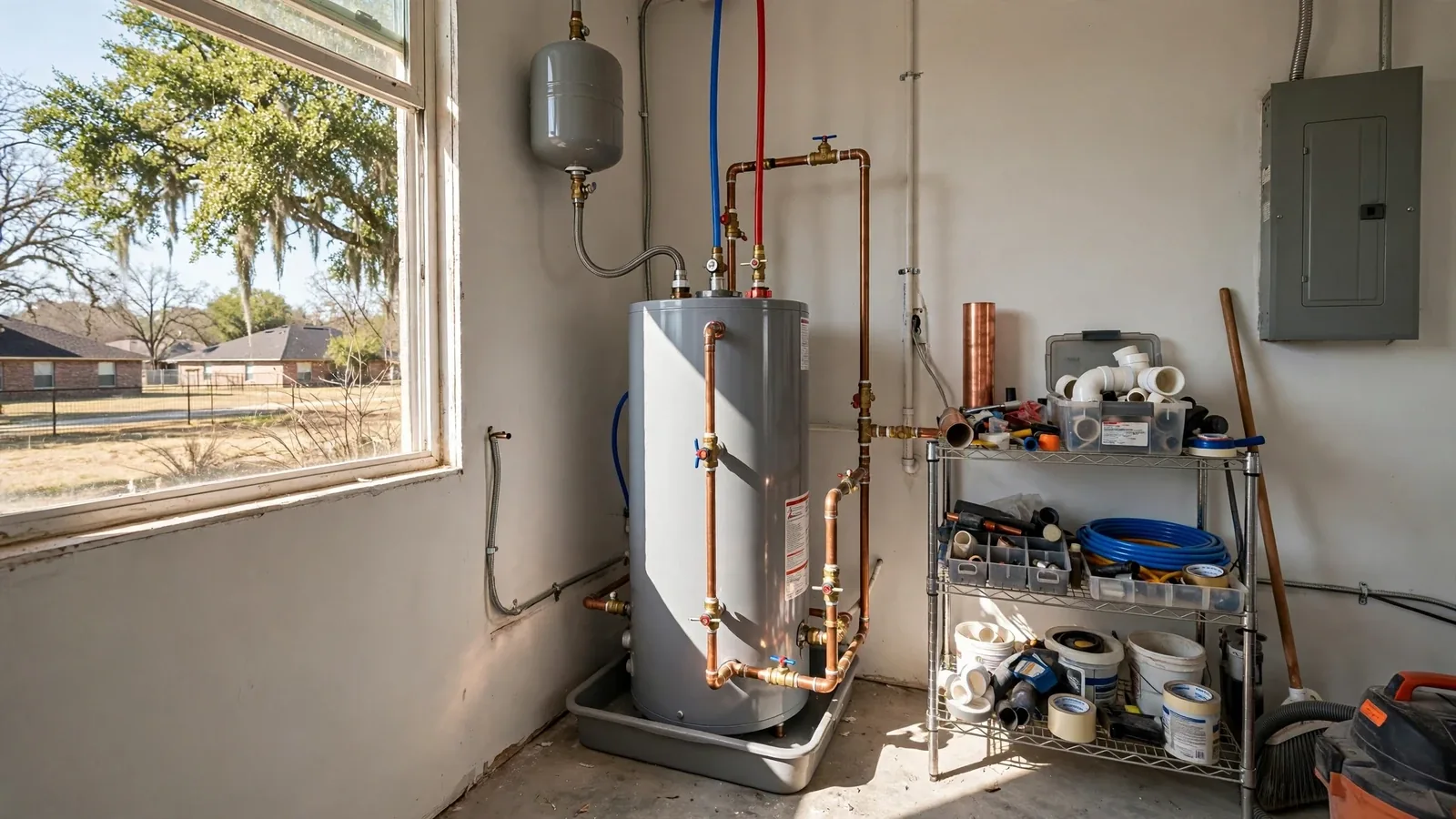
What a Proper Installation Includes
A new water heater is a pressure vessel connected to gas or 240 volt power, so the details matter. We set the unit on a level base, connect the cold inlet and hot outlet with new fittings, and install a dielectric union or approved connector where copper meets steel. Then we fill the tank, purge the air, and check every joint.
Everything around the heater counts as part of the install. These items are the ones that usually separate a clean job from a callback.
Temperature and pressure relief valve
The T&P valve opens if the tank gets too hot or pressure climbs too high. Its discharge pipe runs to a safe point, never capped and never reduced in size. A missing or capped discharge is a serious hazard.
Expansion tank and pressure
When water heats it expands, and in a closed system that pressure has nowhere to go. A small expansion tank on the cold line absorbs it and protects the fixtures and the heater itself. We check house pressure with a gauge and size the tank to match.
Pan, drain, and shutoffs
A drain pan with a pipe to a safe discharge point catches small leaks before they reach the floor. We install a full-port shutoff on the cold inlet so the next service call is simpler. A gas unit also gets a shutoff and a sediment trap on the gas line.
Codes We Work To in Crowley
Crowley has adopted the 2021 International Plumbing Code, 2021 International Residential Code, 2021 International Fuel Gas Code, and 2021 International Mechanical Code, among others. Here is what each means for a water heater.
Plumbing (IPC)
Sets rules for water piping, the relief valve discharge, and backflow protection. It is the base standard for how the tank connects to the home's supply.
Residential (IRC)
Covers installation in a house, including clearances and where a heater may sit. A closet or garage location comes with its own rules.
Fuel gas (IFGC)
Governs gas piping, shutoffs, and sizing. A gas heater needs a gas line that can carry the load, which we check before the unit goes in.
Mechanical (IMC)
Controls venting and combustion air. A poorly vented gas heater can push exhaust back into the home, so venting is never an afterthought.
Permits and the Crowley Building Department
Ask Before You Start
Permit rules vary, so ask the Crowley building department whether your water heater job needs one. The permits office answers at 817-297-2201, extension 3000, and inspection requests use extension 3020. Hours are Monday to Thursday 7:30 to 5:30 and Friday 7:30 to 11:30. Applications go through the city's MyGov portal.
Gas, Electric, or Tankless: What Each Install Needs
The fuel type and style drive the work. This table compares the main options.
| Type | What the install needs | Watch for |
|---|---|---|
| Gas tank. | Gas line, flue vent, combustion air, T&P discharge. | Venting and draft, carbon monoxide safety. |
| Electric tank. | 240 volt circuit, correct breaker, T&P discharge. | Panel capacity, wire gauge. |
| Gas tankless. | Gas line sized for the load, stainless vent, condensate drain. | Larger gas line, venting through a wall or roof. |
| Electric tankless. | Heavy-gauge dedicated circuit and large breaker. | Panel upgrades are common. |
| Hybrid heat pump. | 240 volt circuit, space for airflow, condensate drain. | Needs room, runs cooler air into the space. |
See our tankless water heater page for sizing and flow-rate details.
Planning a new water heater?
Call our 24/7 line and a licensed plumber will talk through sizing and fuel, with same-day appointments when available.
How Install Day Goes
A typical tank install runs through the same sequence. A tankless unit adds venting and gas line work.
Walk-through and sizing.
We check the space, the fuel, the venting path, and the household's hot water use. Then we confirm the size, usually 40 or 50 gallons for a family home, and quote a clear price.
Shut off and drain.
We turn off power or gas, close the cold supply, and drain the old tank to a safe spot. Sediment from older tanks often comes out as grit.
Remove and prepare.
The old unit goes out and the area is cleaned. We replace worn shutoffs, supply lines, and venting, and set the new pan.
Set, connect, and vent.
The new unit goes in level. We connect water, gas or electric, the T&P line, and the expansion tank, then check the flue draft on gas models.
Test and explain.
We fill the tank, relight or power up, check for leaks and gas, verify the temperature, and show you the shutoffs. We usually set it near 120 degrees to reduce scald risk.
Why Crowley Water Shapes the Install
The City of Crowley 2025 Water Quality Report lists 6 to 9 grains per gallon of hardness. Hard water leaves scale that settles at the bottom of a tank and coats heating elements. For you, that means a heater here benefits from a drain valve you can reach and an annual flush.
An anode rod protects the steel tank, but it wears faster in some water. We check the rod's location so it can be inspected later. If you want to slow scale, pair the heater with a water softener or filter.
What Changes the Cost of a Water Heater Installation
We give a clear price before work starts. These items drive it.
Homeowners policies usually cover sudden and accidental damage, such as a tank that bursts, and usually do not cover a heater that wore out. Planned replacement is generally a maintenance cost. Ask your carrier if you have a water damage claim attached.
Installation Alongside Other Plumbing Work
A new heater is a good moment to fix other things. If the supply lines are corroded, we can combine the work with broader plumbing installation services. If your current heater still runs but acts up, see water heater repair before deciding to replace.
We install across Crowley and in Burleson, Everman, and Forest Hill. Because Crowley grew 40.8 percent between 2010 and 2020, many installs here are in newer homes, though the same checks apply to every house.
Water Heater Installation Questions
A standard tank swap often takes a few hours. Conversions, venting changes, or tankless installs can take longer. We confirm the scope before work starts.
Permit rules vary, so ask the Crowley building department at 817-297-2201, extension 3000. Community Development is open Monday to Thursday 7:30 to 5:30 and Friday 7:30 to 11:30, and applications go through the MyGov portal.
Often yes, but moving it changes the gas line, venting, and water piping. We look at the new location first to confirm clearances and code requirements.
A 40 gallon tank suits many small households, while a 50 gallon unit is common for larger families. Peak demand, the number of bathrooms, and recovery time all play a role.
Tankless units run around 20 years and save floor space, but they cost more upfront and often need gas line and venting upgrades. Tank units are simpler and run 8 to 12 years.
Yes, removal of the old unit is part of the job, and we tell you in the quote what is included.