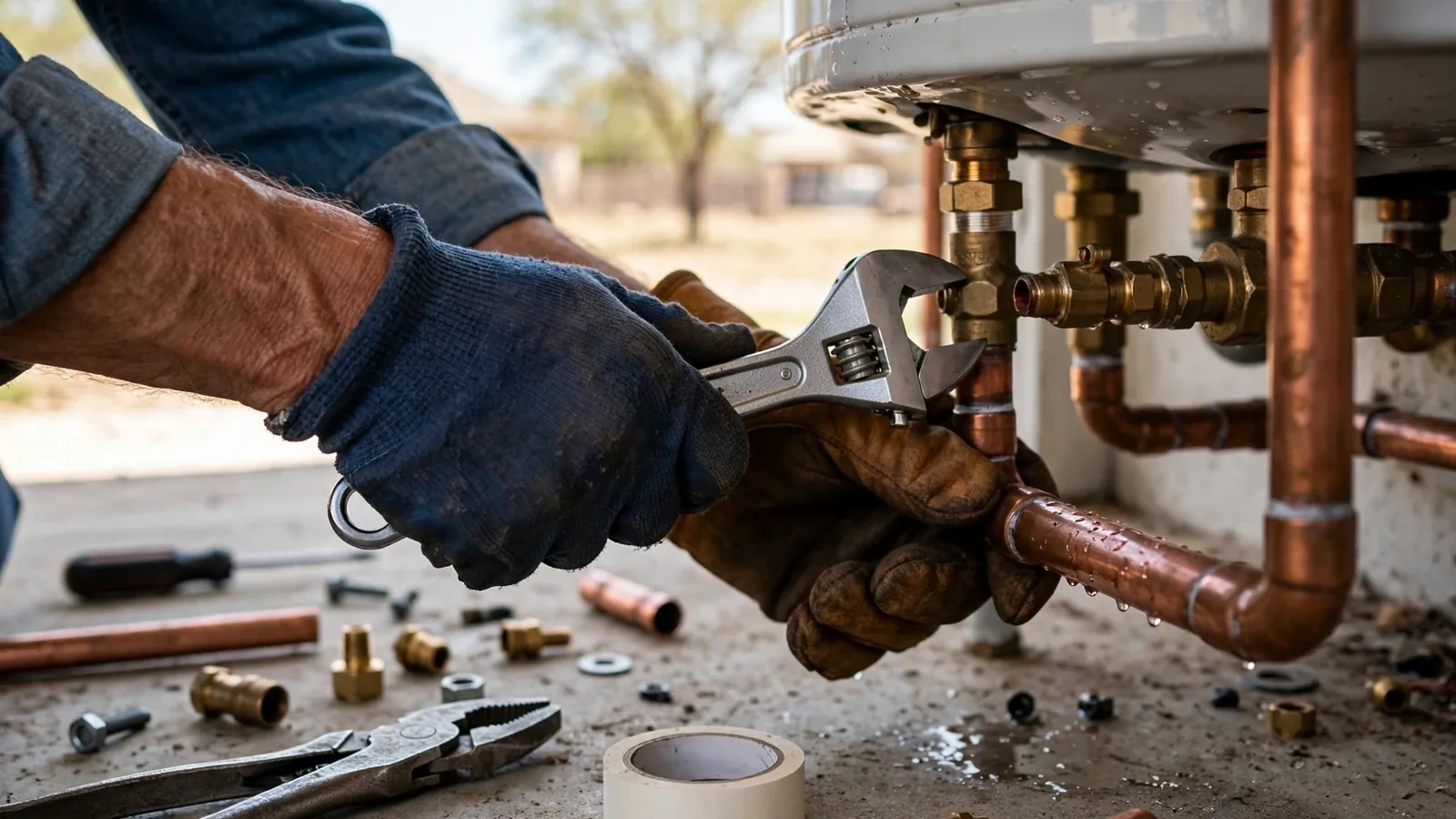
Water Heater Leaking: What to Do in the Next Five Minutes
Water around the tank is why most people call. Your first job is to stop the damage. Cut power to an electric unit at the breaker. On a gas unit, turn the dial on the gas control to off. Then close the cold water shutoff on the pipe above the tank by turning the handle a quarter turn or the wheel clockwise.
Open a hot faucet somewhere in the house so the tank stops pushing water out of the leak. If the water is coming from the top fittings or the T&P valve discharge pipe, a licensed plumber can often fix it without replacing the tank. If it is seeping from the bottom of the tank shell, the steel has failed and repair is not possible.
Keep people and pets out of any room where water has reached outlets, a power strip or the electrical panel. Move stored boxes off the floor. Take a few photos of the tank, the pooled water and the data label on the side, because your insurance carrier and our dispatcher will both ask for the model details.
Safety devices on a water heater, including the T&P valve, are covered by plumbing code standards. Crowley has adopted the 2021 International Plumbing Code, and we never bypass or cap a safety device as a repair.
Where the water is coming from tells you a lot
A drip at the top usually points to a loose or corroded inlet or outlet connection, which is a repair. A steady stream from the side pipe on the tank is the T&P relief valve doing its job because pressure or temperature climbed too high. Water that pools under the unit with no visible source is often a rusted tank, and that means replacement.
Symptom, Likely Cause, and Repair or Replace
Use this as a rough map before the plumber arrives. The final call depends on what the tank looks like inside and out.
| Symptom | Likely cause | Repair or replace |
|---|---|---|
| Puddle under the tank, wet at the bottom seam. | Rusted tank shell or failed lining. | Replace. A steel tank cannot be patched. See water heater replacement. |
| Dripping at the top fittings. | Loose or corroded supply connections. | Repair. New fittings or dielectric unions usually fix it. |
| Water running from the discharge pipe. | T&P valve opening from high pressure or a worn seat. | Repair. Replace the valve and check for thermal expansion. |
| No hot water at all, electric tank. | Tripped high-limit switch, failed element or thermostat. | Repair. Parts are inexpensive relative to the tank. |
| No hot water, gas tank. | Pilot out, bad thermocouple or failed gas control valve. | Repair in most cases. Replace if the tank is old and leaking. |
| Hot water runs out fast. | Sediment buildup or a lower element burned out. | Flush or repair. Replace if the tank is far past 10 years. |
| Rumbling or popping from the tank. | Hardened scale on the bottom of the tank. | Flush and inspect. Heavy scale on an old tank often means replace. |
Tank life is typically around 8 to 12 years. Past that range, a leak almost always means a new unit.
What Crowley Water Does to a Tank
Crowley buys 100 percent of its treated surface water from Fort Worth, and the City's 2025 water quality report gives numbers that matter inside a tank. Three of them are worth knowing.
Hardness: 6 to 9 gpg
The report lists total hardness of 108 to 150 mg/L, or 6 to 9 grains per gallon. Heating hard water drops calcium and magnesium out as scale, which settles on the tank floor and coats electric elements. A yearly flush slows that buildup, and a water softener stops most of it.
pH 7.8 to 8.5
Water in that range leans slightly alkaline, which encourages scale more than it eats metal. The anode rod inside the tank is the part that corrodes on purpose to protect the steel. Once it is gone, the tank walls become the next target.
Chloramine disinfectant
The 2025 average was 2.56 ppm, within the 4 ppm limit. Chloramine can wear on rubber seals and gaskets over the years, which is one reason old T&P valves and fill-valve washers go soft. We check those parts whenever we open a heater.
No Hot Water or Not Heating: Gas and Electric Diagnosis
Water that never gets hot, or turns lukewarm after a few minutes, is a different problem from a leak. The cause depends on whether you have a gas or electric tank. Check the label on the unit or look for a gas line and a flue pipe leading up to the ceiling.
Gas tanks: pilot, thermocouple and gas control
A gas water heater needs a steady pilot flame to keep the thermocouple warm. If the flame keeps going out, the thermocouple is usually worn, or a draft is blowing it out. A clogged burner tube or a failed gas control valve will also leave you with cold water.
We do not recommend relighting a pilot on a tank that is leaking, smells of gas or sits in a closet with poor ventilation. If you smell gas at any point, leave the building, call the gas utility or 911 and only then call us. A licensed plumber tests the gas connections with a manometer and leak solution before the unit goes back into service.
Electric tanks: breaker, high-limit switch, elements
An electric tank has two heating elements and two thermostats, upper and lower, plus a red reset button for the high-limit switch. A tripped breaker or a burned-out upper element means no hot water at all. A failed lower element means hot water that fades quickly.
A plumber tests each element with a multimeter for continuity and checks for a short to ground. Elements in hard water often fail from scale long before the tank does. We shut off power at the panel before any cover comes off, and we ask that you stay away from the unit until we say it is safe.
No hot water or a leaking tank right now?
Call and a licensed plumber will talk you through shutting things off, then book a same-day visit when available.
T&P Valve and Anode Rod: Check It Yourself or Call
Two small parts decide how long a tank lasts and how safe it is. Here is how to split the work between you and a licensed plumber.
Safe for you to check
- Look at the discharge pipe from the T&P valve for drips, rust or mineral crust.
- Listen for rumbling or popping when the heater runs, which signals sediment.
- Read the data label for the install date and the tank size in gallons.
- Set the thermostat dial to around 120 degrees Fahrenheit to reduce scale and scalding risk.
- Note any rotten egg smell from the hot tap, which can point to a spent anode rod.
Leave it to a licensed plumber
- Testing or replacing the T&P valve, because it protects the tank from rupture.
- Swapping a heating element or thermostat on a live circuit.
- Replacing the anode rod, which can be seized in place after years in hard water.
- Any work on gas valves, flue pipes or the thermocouple.
- Fitting an expansion tank when the house has a closed system and pressure creeps up.
How a Repair Visit Goes
We start by confirming the shutoffs and checking the surrounding area for water damage and safety hazards. Then we read the data plate, check the age and look at the tank for rust, scale and weeping seams. Gas units get a combustion and venting check. Electric units get meter tests on the elements and thermostats.
Once we know the cause, we explain the options and the price before we start the work. If a part will solve it and the tank has useful life left, we repair. If the tank is leaking from the shell, badly scaled or well past its typical 8 to 12 year life, we say so plainly and quote a replacement through our water heater installation service.
For people who want to skip the storage tank entirely, we can also discuss a tankless water heater, which typically lasts around 20 years. The tradeoff is a higher upfront cost and, in many homes, upgrades to gas line size or electrical service.
What Affects the Price of Water Heater Repair
You get a clear price before work starts. The final figure depends on a few things we can see when we arrive.
Most homeowners policies cover sudden and accidental water damage, such as a tank that bursts and floods a room. They usually do not cover a slow leak or the tank itself wearing out, so ask your carrier before you file.
Know Where Your Cold Shutoff Is Before You Need It
The 2021 winter storm sent many North Texas homeowners hunting for shutoff valves in the dark while water poured from burst lines. Water heaters sit in garages and attic closets where a freeze can crack the supply pipes first. Find the cold shutoff above your tank today and test that it turns. A stuck valve is the most common reason a small leak becomes a big one.
Also locate the main water shutoff for the house and the breaker or gas dial for the heater. Tag them with a strip of tape. If you live near Burleson, our Burleson plumbers see the same winter pattern, and a frozen supply line is easier to fix when the water is already off.
Water Heater Repair Questions We Hear
Yes. Our line is open 24/7, including nights, weekends and holidays, and we book same-day visits when available. A leaking tank or a gas smell does not wait for business hours, so call any time and we will walk you through the shutoffs first.
A leak from the bottom usually means the steel tank has rusted through, often after the anode rod wore away. Sediment and hard water speed that up. Once the shell leaks, a repair will not hold, so shut off the power or gas and the cold supply and plan on a replacement.
No. Water can reach electrical parts, gas controls and the flooring around the unit. Turn off the power or gas, close the cold supply valve and open a hot tap to relieve pressure. Call a licensed plumber before you use the heater again.
On an electric tank, a tripped breaker, a failed upper element or the high-limit reset is the usual cause. On a gas tank, look for a pilot that has gone out, but do not relight it if you smell gas. A plumber can test the thermostat, thermocouple and gas control to find the real fault.
The temperature and pressure relief valve opens if the tank gets too hot or the pressure climbs too high, so it works as a safety stop. A drip can mean a worn seat, high water pressure or thermal expansion in a closed system. Never cap the valve or its discharge pipe.
If the tank itself is leaking or the unit is beyond roughly 8 to 12 years, replacement usually makes more sense. If the problem is a thermostat, element, pilot assembly or valve and the tank is sound, repair is worth it. We tell you which applies and give the price before starting.
With Crowley water at 6 to 9 gpg, an annual flush is a reasonable habit. It clears loose scale from the bottom and helps keep elements and burners working efficiently. If your tank has never been flushed, have a plumber check it first, since old sediment can clog the drain valve.