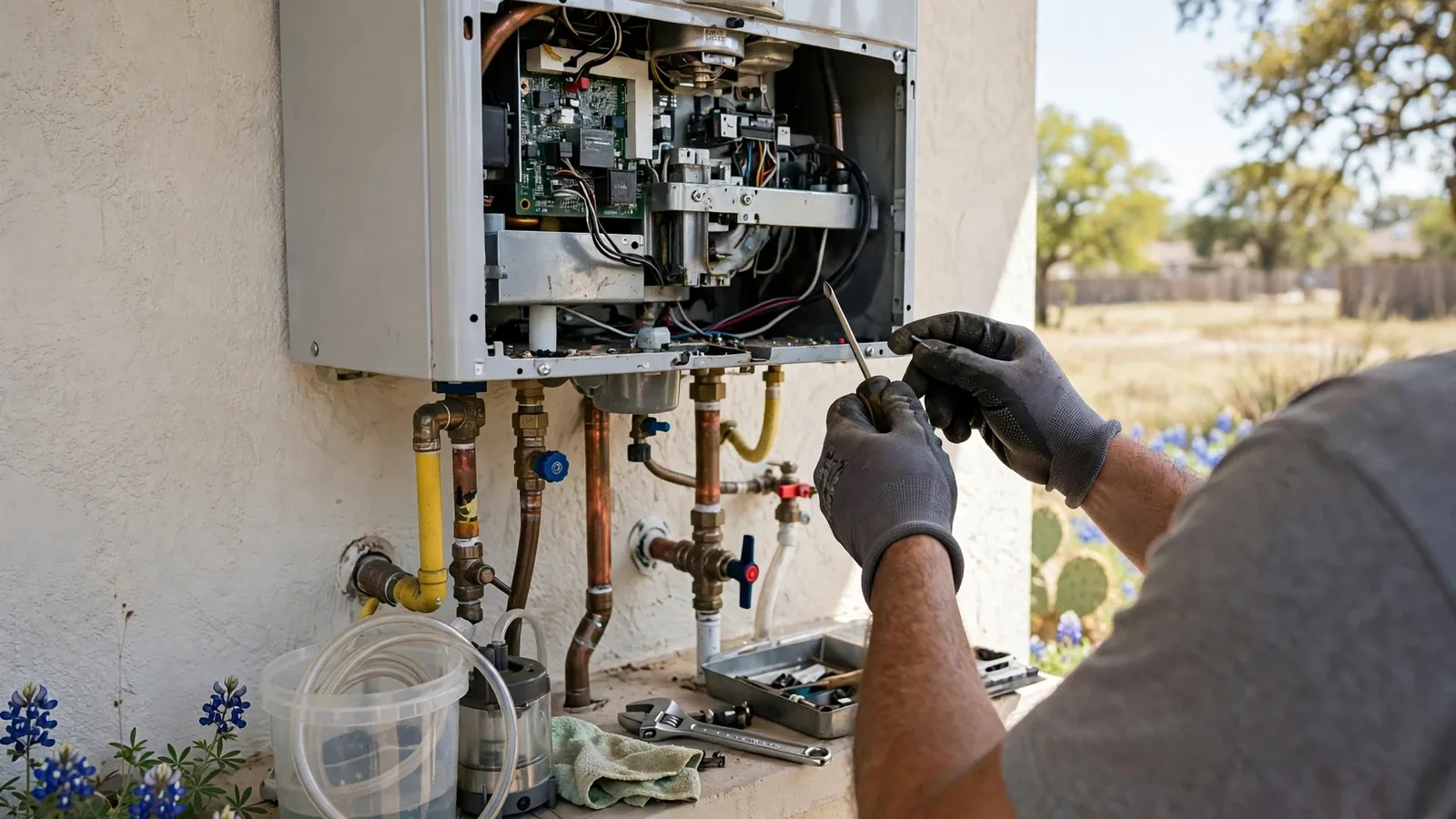
Hard Water and Tankless Heat Exchangers
Crowley's 2025 Water Quality Report lists total hardness at 108 to 150 mg/L as calcium carbonate. The report states that as 6 to 9 grains per gallon. The city buys 100 percent of its treated surface water from Fort Worth, and the pH runs 7.8 to 8.5. That is moderately hard and slightly alkaline.
Heat is where hardness bites. Calcium and magnesium come out of solution when water is heated, and a tankless heat exchanger heats water from cold to 120 degrees in seconds across narrow copper or stainless passages. Scale forms inside those passages, narrows the flow and forces the burner to work harder to reach the set temperature.
That is why a flush on a regular schedule is the single best thing you can do for a tankless unit here. Many makers call for a flush about once a year in hard water areas, and sooner if you see a drop in flow or hot water temperature. If you want to cut scale at its source, a water softener or filter on the house supply protects the heater and every other fixture.
Gas tankless units fall under the venting and combustion air standards in the 2021 International Fuel Gas Code and Mechanical Code, both of which Crowley has adopted. Ask the Crowley building department how it applies to your home.
What a Tankless Flush and Descale Involves
A proper flush takes a licensed plumber about an hour for a typical unit, and it needs the right fittings. Skipping the service valves on a new install is the most common reason owners cannot do it.
Shut off power or gas, and the water.
We turn off the electric breaker or the gas valve, close the cold and hot isolation valves, and let the unit cool. Never flush a heater that is still hot.
Connect a pump and a hose loop.
Hoses attach to the service ports on the isolation valves, and a small pump circulates a descaling solution, most often white vinegar or a mild acid cleaner, through the heat exchanger.
Circulate for 45 minutes or more.
The solution sits and circulates while it dissolves the scale. Heavily scaled units may need longer or a repeat cycle.
Rinse and clean the inlet screen.
We flush the unit with clean water to remove all solution and loosened scale, then clean the inlet water filter and check for leaks.
Test flow and temperature.
We reopen the valves, restore power or gas, run a hot tap and check the temperature rise and error history. Then we log the date so you know when the next flush is due.
Tankless Work We Handle
Every job starts with a conversation about your house and your hot water use. Here are the main types of work.
New tankless installation
We size the unit for your flow rate in gallons per minute and your incoming water temperature. Gas units need proper venting and often a larger gas line, and electric units need heavy circuits. Permit rules vary, so ask the Crowley building department, and we handle the details with you. See water heater installation for general install information.
Repair and error codes
Ignition failures, flame sensor faults, flow sensor problems and and cold-water sandwiches are all fixable. We read the error code, check the filter and test the parts before suggesting a part swap. For other heater types, see water heater repair.
Flush and descale service
We use isolation valves, a pump and a descaling solution to clear scale, then test performance. If your unit has no service valves, we can add them.
Replacement of an old tank heater
Switching from a tank to tankless means moving the gas line and vent, and sometimes the wall space. We lay out the changes before any work starts. If you want to compare, water heater replacement covers tank options.
Tankless unit not heating?
Call any hour. Our line is open 24/7, and a licensed plumber can often come the same day.
Common Tankless Symptoms and Likely Causes
Most tankless problems follow a pattern. This is how we usually narrow it down.
| Symptom | Likely cause | What we do |
|---|---|---|
| Water never gets hot enough | Scale on the heat exchanger or a clogged inlet filter | Flush and descale, clean the filter. |
| Temperature swings from hot to cold | Flow below the minimum activation rate, or a failing sensor | Check flow rate and test the sensor. |
| Error code and no heat | Ignition, flame, vent or sensor fault | Read the code, test parts, repair or replace. |
| No hot water at one faucet | Long pipe run or low-flow fixture | Check flow at the unit, consider a recirculation line. |
| Noise, rumbling or banging | Heavy scale or a partly blocked exchanger | Flush and descale, test pressure. |
Gas units that smell of gas need a different response. Leave the building and call the gas utility or 911 before you call a plumber.
Tankless or Tank: Which Fits Your House
Tankless is not right for every home. Here is an honest look at both.
Tankless makes sense when
- You want to free floor space and avoid standby heat loss.
- You can run a larger gas line or heavy electric circuit.
- You have a regular flush plan and accept the annual cost.
- You plan to stay in the home a long time. Tankless units often last around 20 years.
A tank may be better when
- You want the lowest upfront cost and simplest install.
- Your venting or gas line would need major changes.
- You never maintain equipment and hard water is not addressed.
- A tank, with an 8 to 12 year life, fits your budget this year.
What Affects the Price of Tankless Work
We confirm a clear price before work starts. These are the things that set it.
Insurance usually covers sudden and accidental damage, such as a burst supply line, and usually does not cover wear, scale or normal replacement of a heater. Ask your carrier if you are unsure.
Tankless in Crowley Homes and Nearby Towns
Homes in Crowley range from the older core around the railroad downtown to subdivisions such as Mayfair, Mayfair South and Sendero Oaks. We never guess the age of your pipes or your gas line. A quick look at the meter, the gas line size and the venting path decides what the upgrade needs.
Neighbors in Burleson face similar hard water, with the City of Burleson reporting 5 to 10 grains per gallon in its 2024 report. If you are comparing a tankless heater to your existing setup, call and tell us what you have now. We can talk through a flush plan first, and a new install second.
Tankless Water Heater Questions
Crowley water is 6 to 9 grains per gallon, so plan on about once a year, and sooner if hot water gets weak or the unit shows scale error codes. Your owner manual may set a different interval, and a softener on the house supply can stretch it out.
Some owners do it with service valves, a pump, hoses and white vinegar. The risk is leaks, a hot unit, and missing the filter. If your unit has no isolation valves, call a plumber to add them before you start.
Many warranties exclude scale damage or require annual flushing in hard water areas. Check the paperwork for your unit and keep flush records. We note the date and result on every service.
It often means the flow is below the minimum needed to fire the burner, or the heat exchanger or sensor is scaled. A flush and a flow check usually find it.
It can be if you have the space and the gas or electric supply to run one. Savings come from no standby heat loss, but unit and install cost are higher than a tank. We lay out both so you can compare.
Yes. Our dispatch line is open 24/7, and a licensed plumber can come out for no hot water the same day when available. For a planned flush or install, we schedule a time that suits you.