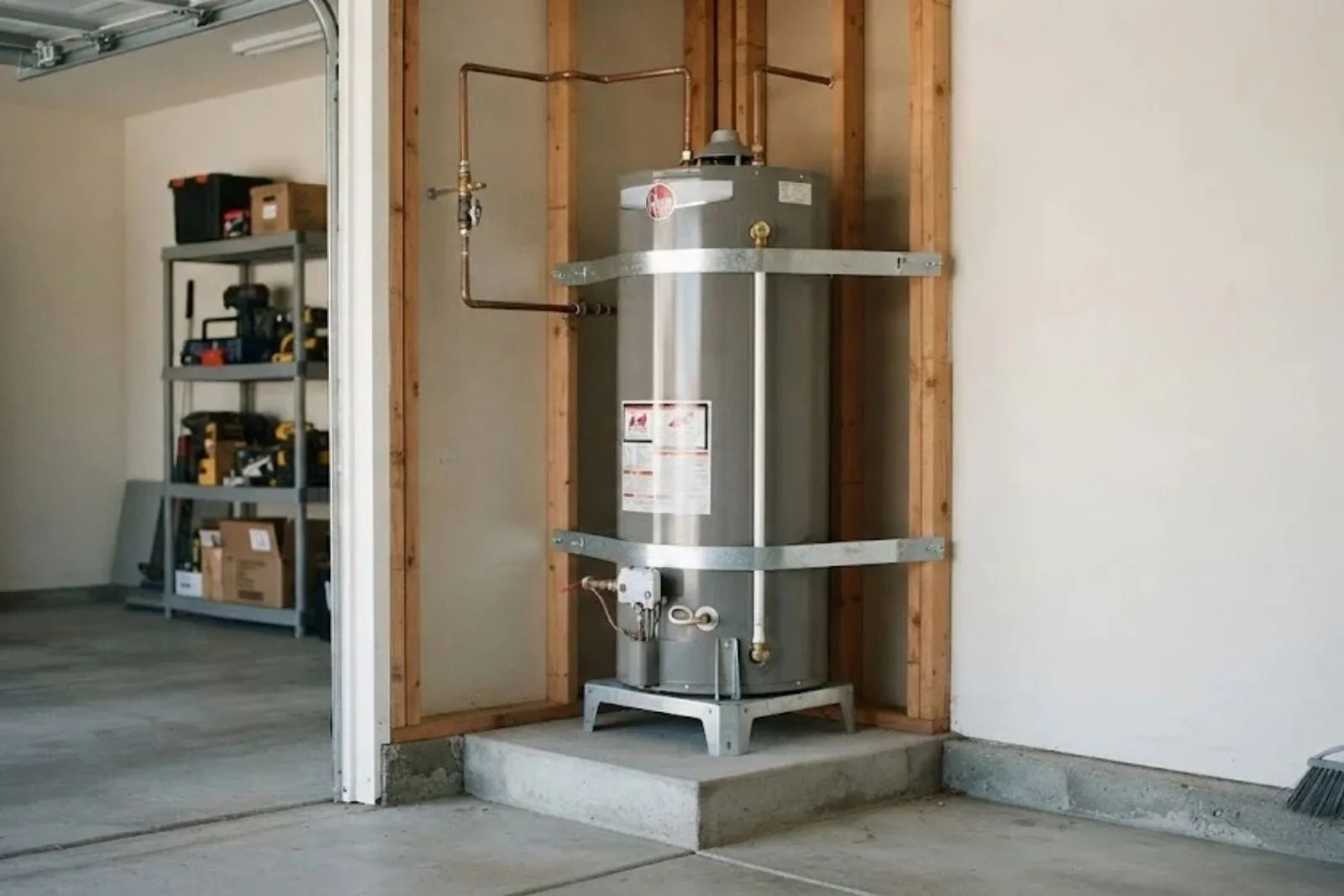
The Tank Is Leaking Right Now: Do This First
Four moves that limit the damage
Shut off power or gas to the unit. For an electric heater, flip the dedicated 240 volt breaker. For gas, turn the control knob to off, and never relight a pilot on a leaking tank.
Close the cold water valve on the pipe feeding the top of the tank. Then open a hot faucet somewhere in the house so the tank can drain down instead of pushing water onto the floor. If the floor is soaked and the heater is electric, stay out of the water until the breaker is off.
What Crowley Water Does to a Steel Tank
A typical tank-style heater lasts about 8 to 12 years. The City of Crowley's 2025 water quality report puts total hardness at 108 to 150 mg/L, which the report states as 6 to 9 grains per gallon. That is moderately hard water, and it drops scale on the bottom of the tank every time the burner or lower element runs.
Scale matters because it insulates. On a gas unit the flame has to heat through a layer of sediment, so the steel runs hot and the tank fatigues. On an electric unit the lower element gets buried and burns out. This is why a tank that is never flushed often fails closer to the 8 year end of the range than the 12 year end.
The disinfectant matters too. Crowley buys 100 percent of its treated surface water from Fort Worth, and the report lists chloramine at a 2025 average of 2.56 ppm, under the 4 ppm limit. Chloramine and a pH between 7.8 and 8.5 are both within standards, but the anode rod inside the tank is a sacrificial metal that slowly gets consumed, and once it is gone the steel itself starts to corrode.
Repair or Replace: A Quick Decision Table
Not every dead heater needs a new tank. A bad element, thermostat or gas control valve is a repair, and our water heater repair visits fix those every week. A leaking tank is different, because the leak is in the steel and no part fixes it.
| What you see | Likely cause | Usual answer |
|---|---|---|
| Water pooling under the tank body | Corroded or cracked steel shell | Replace the tank. |
| Leak at the T&P valve or pipe fitting only | Failed valve, loose connection or thermal expansion | Repair, then check expansion pressure. |
| Lukewarm water, electric unit | Burned-out lower element or tripped thermostat | Repair if the tank is sound. |
| Rumbling or popping from the tank | Heavy sediment layer | Flush, or replace if over 10 years old. |
| Rusty hot water only | Anode rod gone, tank interior corroding | Replace the tank. |
| No heat, gas unit, tank dry outside | Thermocouple or gas control valve | Repair. |
Age is the tiebreaker. A 12 year old tank with a small problem usually costs more to nurse along than to replace.
Signs the Tank Has Reached the End
Most tanks warn you for weeks before they let go. If you catch these early, you can schedule the swap instead of mopping up at midnight.
Moisture at the base
Even a ring of dampness on the drain pan or slab around the tank means the shell is seeping. Seams in the steel do not seal themselves.
Rust-colored hot water
If the cold side runs clear and only the hot side is brown, the inside of the tank is rusting. Replacement is coming.
Banging and popping
Water trapped under hardened scale flashes to steam and knocks. It wastes fuel and stresses the steel.
Fewer hot minutes
A tank full of sediment holds less hot water than its label says. If your 40 gallon unit now feels like 25, sediment has taken the room.
Corroded fittings on top
White or green crust on the inlet and outlet nipples points to slow leaks and failing dielectric unions.
Age over 10 years
The data plate on the side lists a serial number that encodes the build date. If it reads past the 10 year mark, plan the swap before it plans you.
Water heater down tonight?
Call (817) 601-6266 and a licensed plumber will talk you through shutoffs and book the earliest visit available, day or night.
Sizing the New Heater
Size is set by how much hot water you use in the busiest hour, not by how big the old tank was. A 40 gallon tank usually covers one to three people, a 50 gallon unit suits a family of four, and a 75 gallon tank handles a big household with a soaking tub. Look at the first hour rating on the yellow EnergyGuide label, because that number tells you what the unit can actually deliver.
Fit matters as much as capacity. Newer tanks are often a few inches wider or taller than the units they replace because of added insulation, and a closet or garage corner that held the old one might not clear a new vent or drain pan. We measure before we order, which avoids the half-installed heater that no one wants to see on a Friday evening.
Tank or tankless?
A tank is the simplest like-for-like swap and the lower upfront cost. A tankless water heater lasts around 20 years and never runs out mid-shower, but it needs a bigger gas line or heavy electrical service and, in hard water, regular descaling. If you are weighing the jump, our team can compare both on your house.
The full process for either type is laid out on our water heater installation page, including venting and gas line sizing.
What Replacement Day Looks Like
A straight swap of a standard tank usually fits inside one visit. Here is the order we work in.
Drain and disconnect.
We shut off the fuel, close the cold valve and drain the old tank through a hose to a floor drain or outside. Then we disconnect the supply lines, the gas line or electrical whip, and the vent.
Set the new tank.
The new unit goes on a fresh drain pan piped to a safe discharge point where space allows. We level it and check clearances to walls and anything combustible.
Connect, vent and test.
New flexible connectors, a T&P valve with a discharge line to within a few inches of the floor, and a properly pitched flue go in. Gas joints get a leak test with bubble solution, and the burner or elements are checked for a clean start.
Walk through the settings.
We set the thermostat, show you the shutoff valves and breaker, and explain flushing. You should leave knowing where every control is.
Details a Good Install Should Include
These are the items that separate a tank that lasts 12 years from one that fails at eight. Ask any plumber, including us, whether they are part of the quote.
- Expansion tank.When water heats it expands, and in a closed system with a check valve or pressure reducer on the service line that pressure has nowhere to go. A small expansion tank on the cold line protects the T&P valve and your fixtures, and it is what we check first when a new heater keeps weeping from the relief valve.
- Correct venting.Atmospheric gas units use a draft hood and a B-vent. Power vent and condensing models use PVC or CPVC and need a drain or condensate route. The vent material is set by the heater, not by preference.
- Dielectric or brass fittings.Mixing copper and the steel nipples on the tank without a proper transition speeds up corrosion at the joint.
- A level, solid base.The tank should sit level on a stable platform or pan, with room left to reach the anode rod and the drain valve.
- A shutoff you can reach.A full-port ball valve on the cold line saves you from the next emergency.
Permits, Codes and Checking Your Plumber
Crowley has adopted the 2021 International Plumbing Code and the 2021 International Fuel Gas Code, and the city's posted local amendments do not address water heaters. Permit rules vary, so ask the Crowley building department at 817-297-2201 ext. 3000 whether a replacement in your house needs one. We can tell you what we normally pull, but the city makes the call.
You can also verify any plumber yourself. Ask for the company's Responsible Master Plumber and look that license up in the Texas State Board of Plumbing Examiners public license search. It also shows whether a certificate of insurance is on file. A plumber who hesitates on that request has told you something.
What Affects the Price of a Water Heater Replacement
We give you a clear price before work starts, and it is built from a short list of real variables. Here is what moves the number up or down.
Homeowners policies usually cover sudden and accidental damage, such as a tank that bursts and floods a room, and usually do not cover a slow leak or wear on the heater itself. Photograph the damage before you clean up and ask your carrier what applies.
Crowley Homes and the Water Heater Question
Crowley grew 40.8 percent between the 2010 and 2020 census counts. Many homes around FM 1187 and FM 731 are comparatively recent, while the older core near the railroad downtown has had more time to build up scale and old piping. We assume nothing about a named subdivision and look at each tank's data plate and plumbing instead.
If you are just south in Burleson, the city's own report lists hardness of 5 to 10 grains per gallon, so the same scale habits apply on that side of the line.
Questions We Hear About Replacing a Tank
Yes. We are open 24/7, and a leaking or failed tank is one of the calls we take at any hour. Tell us whether the unit is gas or electric and what size is on the label, and we will walk you through shutting it down and book the earliest same-day or after-hours visit available.
Plan on about 8 to 12 years. Crowley water measures 6 to 9 grains per gallon of hardness, so flushing the tank once a year and checking the anode rod every few years gets you nearer the long end of that range.
It depends where the water comes from. A leak at the element gasket or the T&P valve can be fixed. Water seeping from the bottom of the shell means the steel has failed, and replacement is the only real answer. Turn the breaker off before anyone touches the unit.
Permit rules vary, so ask the Crowley building department at 817-297-2201 ext. 3000. The permits office is open Monday to Thursday 7:30 a.m. to 5:30 p.m. and Friday 7:30 a.m. to 11:30 a.m. We will tell you what the job involves so your answer is accurate.
Maybe. Tankless lasts longer and saves floor space, but it needs adequate gas supply or electrical capacity and benefits from descaling in hard water. Read about the tankless option and we can quote both so you can compare.
We haul it away as part of the job, since a 40 gallon steel tank is heavy, and we cap or reconnect the lines so you are not left with loose piping.