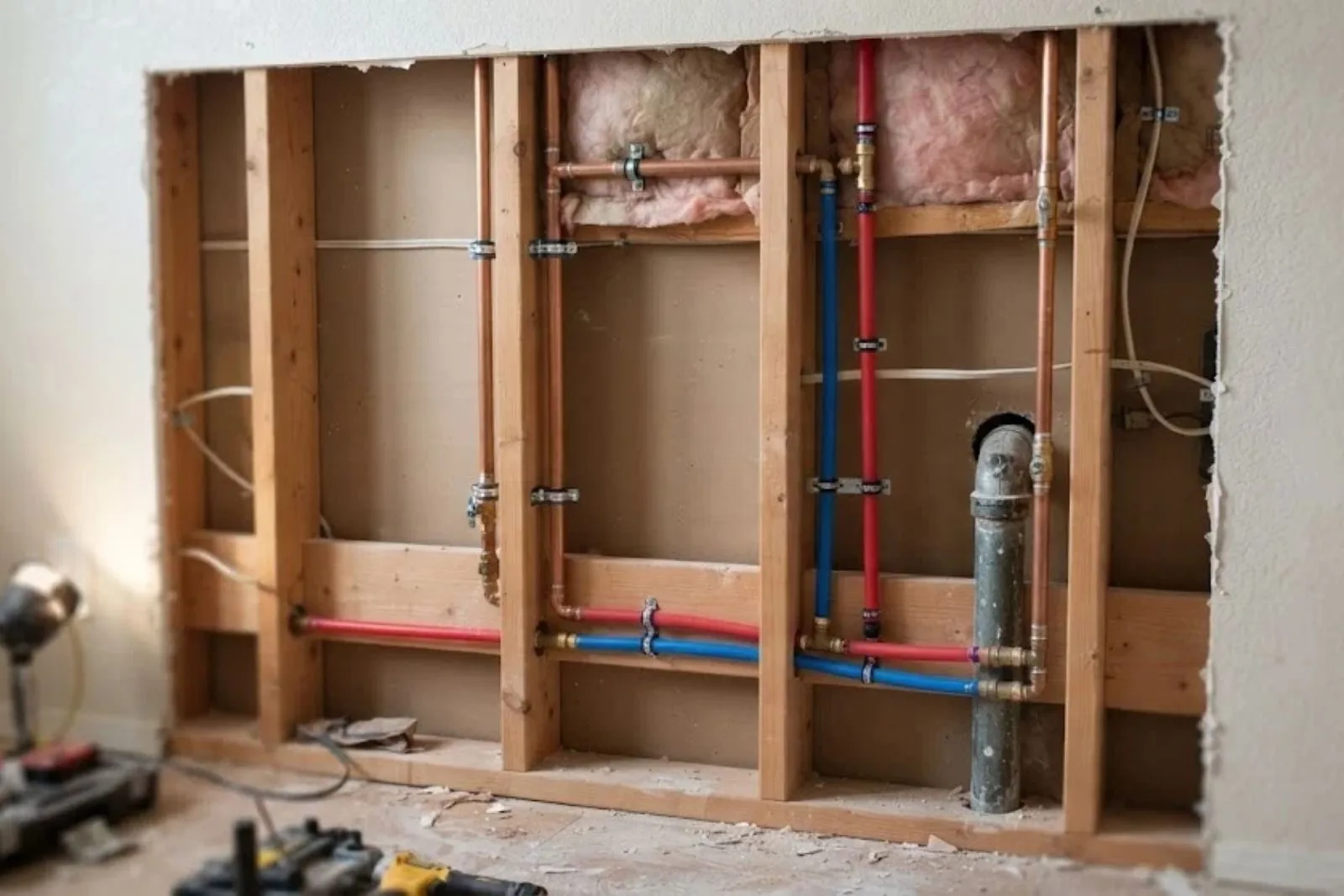
Signs the Pipes Are Wearing Out
One leak is bad luck. These patterns usually mean the system itself is the problem.
Repeated pinhole leaks
A second or third pinhole in the same line suggests the pipe wall is thinning. Patching each one costs more over time than replacing the run.
Rusty or brown water
Rust-colored water from the hot or cold tap, especially first thing in the morning, points to corroding steel. It can clear after running a while, but it keeps returning.
Low pressure everywhere
Old galvanized pipe fills with mineral and rust inside, shrinking the opening. You may see a shower that slowly turns into a trickle.
Visible green or white crust
Crusty buildup at fittings and joints signals active seepage. It often shows up under sinks and near the water heater.
Wet spots with no source
A damp wall, stain, or high water bill with nothing obvious wrong needs leak detection first, and may lead to a repipe if the lines are failing.
Pipes flagged at inspection
A home inspector may note a known problem material during a purchase. That is a good time to plan the repipe on your terms.
The Materials That Cause Trouble
This is general trade knowledge, not a claim about any specific Crowley home. Homes built before the mid-1990s may still have polybutylene, the gray plastic supply pipe used in many US houses until that time. It can become brittle and fail at fittings, which is why plumbers recommend replacing it when found.
Older homes in any city may have galvanized steel, which rusts from the inside and slows flow, or cast iron drain stacks. Newer construction commonly uses copper, CPVC, or PEX, and each has its own failure patterns. Finding out what you have is step one, and we can identify it quickly during a visit.
A repipe is code work. Crowley has adopted the 2021 International Plumbing Code, and the state's licensing standard means you can verify any plumber in the Texas State Board of Plumbing Examiners public license search before work starts.
Pipe Types Compared
Here is how the common supply pipe materials behave over time.
| Material | Common trouble | Repipe note |
|---|---|---|
| Polybutylene (gray). | Brittle fittings, sudden failure. | Replace the whole supply system. |
| Galvanized steel. | Internal rust, weak flow, stains. | Replace, since it only gets worse. |
| Copper. | Pinholes, joint leaks, pitting. | Spot repair if isolated, repipe if widespread. |
| CPVC. | Brittle with age, cracks at fittings. | Repair or replace sections, depending on condition. |
| PEX. | Rare issues, mostly at fittings. | Often the material we replace with. |
Pipe type is only one factor. Water pressure, installation quality, and soil contact all affect how long a line lasts.
What the Water Report Says About Copper
The City of Crowley 2025 Water Quality Report lists the copper 90th percentile at 0.164 ppm against the 1.3 ppm action level. That means the sampled homes were well below the limit set for copper in drinking water. For you, a leak or a blue-green stain in your house is more likely a local pipe issue than a citywide problem.
Corrosion still happens at the fitting level. If copper pinholes keep recurring, we look at velocity, joint quality, and any contact between copper and concrete or soil, rather than blaming the water.
Spot Repair or Whole House Repipe
The right answer depends on the pipe, the damage, and how long you plan to stay.
Repair a section when
- One leak in an otherwise healthy line.
- The pipe is copper or PEX in good shape.
- The damage came from a single event, such as a nail or a freeze.
- You can reach the section easily.
- Water tests and pressure checks look normal.
Repipe when
- Leaks keep returning in different spots.
- The home has polybutylene or heavily corroded galvanized.
- Water turns brown or pressure keeps falling.
- You are remodeling and walls are already open.
- Repair costs are catching up to replacement.
Not sure what is behind your walls?
Call our 24/7 line and a licensed plumber can look at your pipes and tell you whether repair or repiping makes sense.
How a Repipe Works
We plan the job to keep disruption low, and we explain each step before work starts.
Inspect and plan.
We trace the existing supply lines, check pressure with a gauge, and decide on a route for new pipe. Then we lay out a plan with a clear price.
Protect the house.
We cover floors and furniture, and shut off the water at the main. Most repipes are done over a day or two, though larger homes take longer.
Open access points.
We cut small openings in drywall or work through attics and crawlspaces where possible. We aim to run new lines through paths that need the least patching.
Install, test, and reconnect.
New lines go in with proper support and fittings, and we pressure-test before closing anything up. Then we reconnect fixtures, the water heater, and shutoff valves.
Copper Repair and CPVC Replacement
Many calls we get are not full repipes. A copper line with one pinhole or a failed joint can often be cut out and replaced with a new section. We use press fittings or sweated joints, and we check nearby pipe for the same wear.
CPVC is common in newer homes and is usually fine, but it can crack at fittings or in sunlit areas as it ages. If a section fails, we replace it and look at the surrounding runs. When damage is sudden, such as a cracked line flooding a room, our burst pipe repair team can step in.
Newer Homes Are Not Immune
Crowley's population grew 40.8 percent from 12,838 in 2010 to 18,070 in 2020, which means many homes here are comparatively recent. Newer does not mean problem-free. Poor installation, high pressure, or a defective fitting can lead to leaks regardless of age. We make no assumptions about your home. We inspect what is there.
If your service line from the meter to the house is the issue, it is a separate job covered under water service line repair. And for leaks under floors, see slab leak repair.
Check Any Plumber's License
Use the TSBPE Public License Search
Before a big job, ask the company for its Responsible Master Plumber and check that number in the Texas State Board of Plumbing Examiners Public License Search. Master Plumber numbers start with M. The search also shows whether a Certificate of Insurance is on file, which matters on a job this size.
What Determines the Cost of Repiping
Repiping is a project, so we quote a clear price before work starts. These are the factors.
Homeowners policies usually cover sudden and accidental damage, such as a pipe that bursts, and usually do not cover pipes that failed from age or wear. A repipe done for aging pipes is generally not covered, but ask your carrier about damage already caused.
Repiping in Crowley and Beyond
We serve Crowley neighborhoods across the city, from the area around FM 1187 and FM 731 out to the edges of town. We also work in Burleson, Everman, and Forest Hill, where older homes may need pipe checks.
If a pipe is leaking right now, close the main valve and call (817) 601-6266. We handle urgent leaks after hours and plan larger repipes at a time that suits you. For adding lines in a remodel, see plumbing installation.
Repiping Questions
Recurring leaks, brown water, falling pressure, or known polybutylene or galvanized pipe are the main signs. A licensed plumber can inspect and tell you if repair or repiping fits.
Many homes take a day or two, though size and access change that. We explain the schedule and water shutoff times before work starts.
Some access openings are usually needed. We use attics, crawlspaces, and closets where possible to keep patching small.
PEX and copper are common choices, and the right one depends on your home and preference. We explain the trade-offs and give you a clear price.
Yes, when the damage is isolated. If pinholes keep appearing in different spots, repiping often costs less over time.
Gray plastic pipe, often with plastic or metal crimp fittings, can be polybutylene. Homes built before the mid-1990s may have it. A plumber can confirm by looking at the pipe markings.