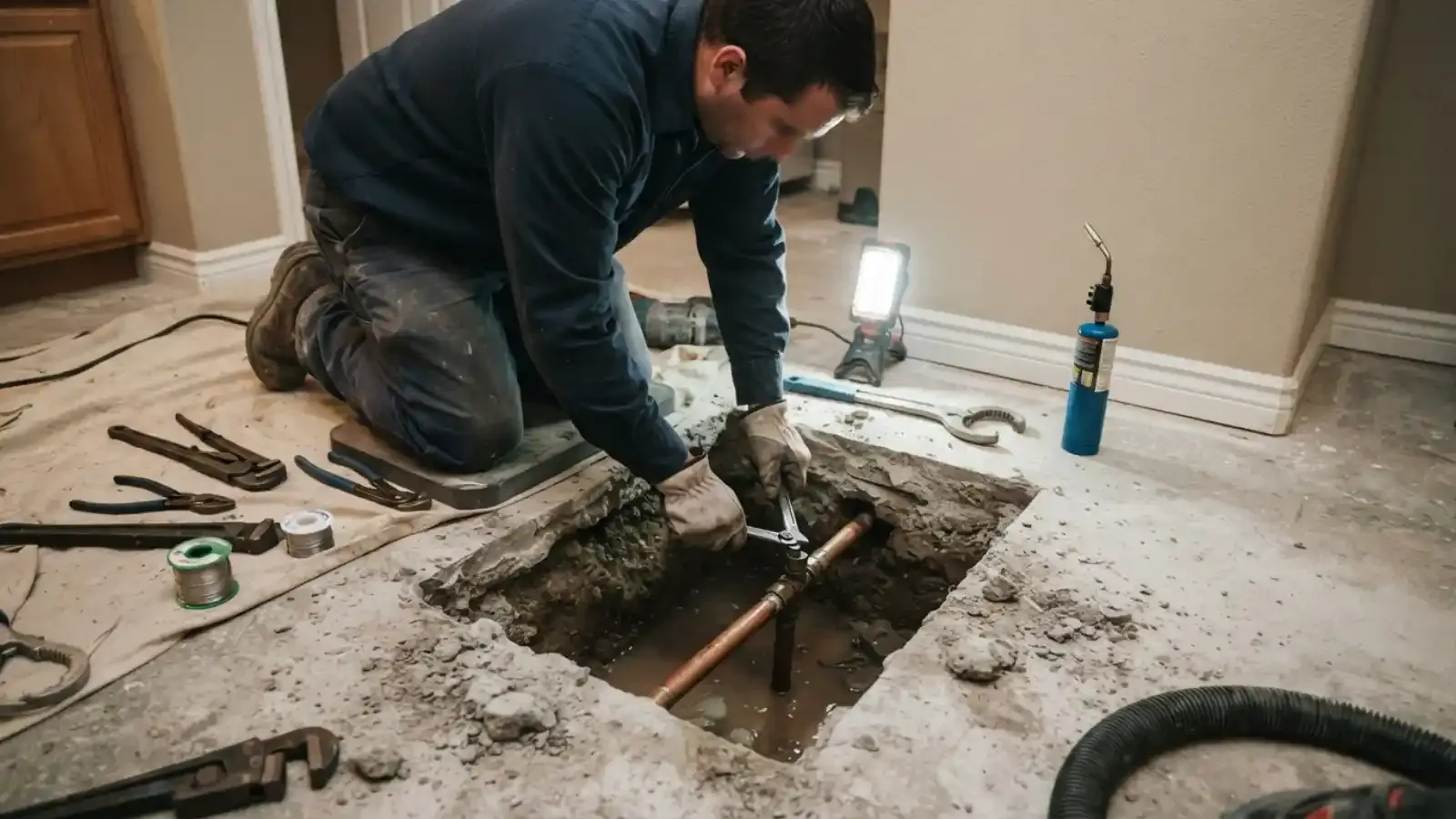
Water Under the Floor: Signs of a Slab Leak
The leak hides under concrete, so signs show up in the house first. Two or more means an active leak.
A warm spot on the floor
A hot water line leaking under the slab heats the concrete above it. Bare feet find it before anything else does.
A meter that keeps moving
With every faucet and appliance off, the leak-indicator triangle or dial on the meter should sit still. If it spins, water is going somewhere.
The sound of running water
A faint hiss or trickle in a quiet house, with no fixture running, usually means a pressurized line is open to the soil.
Wet carpet or lifting flooring
Moisture rising through the slab damp-stains carpet, buckles laminate and loosens tile grout along a straight path.
Musty smell or new cracks
Mildew near baseboards and fresh cracks in drywall or tile can follow a leak that has been running for days.
A sudden jump in the water bill
Compare the last two bills. A pinhole in a 3/4 inch supply line can pour out hundreds of gallons a day.
Why Slabs Leak in This Part of North Texas
In this part of North Texas the soil is clay-heavy. It swells when it is wet and shrinks when it is dry, and the slab above it shifts with it. Most homes here sit on slab-on-grade foundations, so copper or PEX lines run through or under the concrete, and each season of movement rubs the pipe against gravel, rebar or a sharp edge of the slab.
Water chemistry plays a part too. Crowley buys 100 percent of its treated water from Fort Worth, with total hardness of 108 to 150 mg/L (6 to 9 grains per gallon) and pH of 7.8 to 8.5. Over decades that can leave scale inside older copper, so a tired line may fail at a joint or a thin wall.
Crowley grew 40.8 percent between 2010 and 2020, so many homes are comparatively recent, but age alone does not decide whether a line will leak. Poor bedding, a shifting slab or a bad fitting can fail a young line, and the camera and pressure tests tell us more than the date on the house.
Slab repairs follow the 2021 International Plumbing Code, and Crowley's amendment sets a standard for pipe in corrosive soil: sheathing at least 8 mil thick on metallic piping. That matters when we reroute a line instead of breaking the slab.
How We Locate a Leak Under Concrete
We try to find the leak to within a foot or two before a single cut. That keeps the opening small and the cost sensible.
Confirm the leak with the meter.
We shut off every fixture, watch the meter dial and then isolate sections of the house with shutoff valves. This tells us whether the leak is on the house side of the meter.
Narrow it down by pressure testing.
We cap sections of the line and pressure-test them with gauges. A drop in pressure on one branch marks the zone.
Pinpoint it by sound and heat.
Acoustic ground microphones pick up the hiss of escaping water through concrete, and a thermal camera shows a hot-water line warming the slab. Together they usually mark the spot.
Mark the line path.
An electronic pipe locator traces the route so we know where the pipe runs and what else is near it before anyone cuts. For more on how we find hidden leaks in general, see leak detection.
Spot Repair, Reroute or Repipe: Picking the Fix
There are three honest options for a leaking line under the slab. The right one depends on how many leaks the line has, how long it has been going, and what is above it.
| Option | Best when | Trade-off |
|---|---|---|
| Spot repair through the slab | One leak, pipe otherwise sound, floor easy to patch | Cuts a hole in the concrete and flooring, and other leaks can show up later. |
| Reroute through attic or walls | A line that keeps leaking or runs under tile and cabinets | Walls and ceilings get opened, but the slab stays intact. |
| Full repiping | Several leaks, scaled pipe or multiple failures in a short time | Biggest job up front, and it ends repeat visits to the same line. |
| Monitor and re-test | Very small seep with a clear plan to act if it grows | Water keeps escaping, so this is not a long-term answer. |
We explain each choice by phone and in person before we start, and the price is clear before any work begins.
Think there is water under your slab?
Call any hour. We can often schedule a same-day visit, and a licensed plumber will tell you what to shut off while you wait.
A Local Rule About Pipe in the Ground
Crowley amends Section 305.1 of the 2021 International Plumbing Code. Metallic piping, other than cast iron, ductile iron and galvanized steel, must not sit in direct contact with corrosive soil. Where that applies, the pipe needs sheathing at least 8 mil (0.008 inch) thick.
That matters when you choose a reroute or a new line: bare copper in contact with soil is not a shortcut. Permit rules vary, so ask the Crowley building department whether your job needs one. The city's permits office is at 201 E. Main Street, and a licensed plumber can walk you through what to ask.
What to Do Until We Arrive
These steps limit damage and help us work faster when we get there. None of them require tools beyond a flashlight.
- Turn off the main water valve, usually at the street side meter box or where the line enters the house.
- Open one faucet at the lowest point of the house to drain pressure from the pipes.
- Turn off power to any outlets near wet flooring at the breaker. Do not touch a wet outlet or panel.
- Take photos of wet areas, the meter reading and your water bill for your records.
- Lift rugs and move electronics and furniture to dry ground.
- If you smell gas, leave the building and call the gas utility or 911 before calling a plumber.
If the water has been off for hours and the meter still moves, the leak may be before your shutoff valve, so tell us. We would rather confirm that by phone than send a plumber to the wrong end of the line.
What Affects the Price of Slab Leak Repair
We price each job once we have found the leak. These are the factors that decide the number.
Homeowners policies usually cover sudden and accidental water damage and often cover the cost of reaching the leak, but usually do not cover a slow leak, wear or corrosion. Ask your carrier before work starts, and keep photos and the meter readings.
Slab Leaks Around Crowley and Nearby Towns
Homes along and between FM 1187 and FM 731, and in subdivisions such as Mayfair and Sendero Oaks, share the same clay-heavy soil that shapes slab movement. We do not assume anything about the age or pipe of a neighborhood. We test the line and tell you what we find, then you decide.
A leak that starts at the water service line before the house is a different job, and we cover that on our water service line repair page. If your pipe has burst and water is spraying, read about burst pipe repair as well. We also work in Burleson, where homes sit on similar North Texas clay.
Slab Leak Questions Answered
Yes. Our line is open 24/7. If you hear water running under the floor at 2 a.m., call, shut off the main valve, and we will schedule a licensed plumber as soon as one is available. Same-day appointments are offered when available, and we confirm a clear price before work starts.
Sometimes. A reroute puts new pipe in the attic or walls and abandons the leaking line under the slab, so the concrete stays intact. A spot repair does need an opening in the slab. We tell you which fits your house before we start.
Turn off every faucet and appliance, including the ice maker and irrigation. Look at the leak indicator on the meter: if the dial or triangle moves, water is flowing somewhere. Take a photo and give us the reading when you call.
A long-running leak can soften the soil under the slab and speed up settling in this clay-heavy North Texas ground. A short, quickly repaired leak usually does not. That is another reason not to wait.
It depends on your policy. Sudden and accidental damage is usually covered, and slow leaks and wear usually are not. Call your carrier before repairs, and ask whether they cover access work like cutting the slab.
Not always. If the pipe is otherwise sound and the leak was a one-time failure, a spot repair may be enough. If you have had several leaks or the camera shows scaled copper, repiping often saves money in the long run.