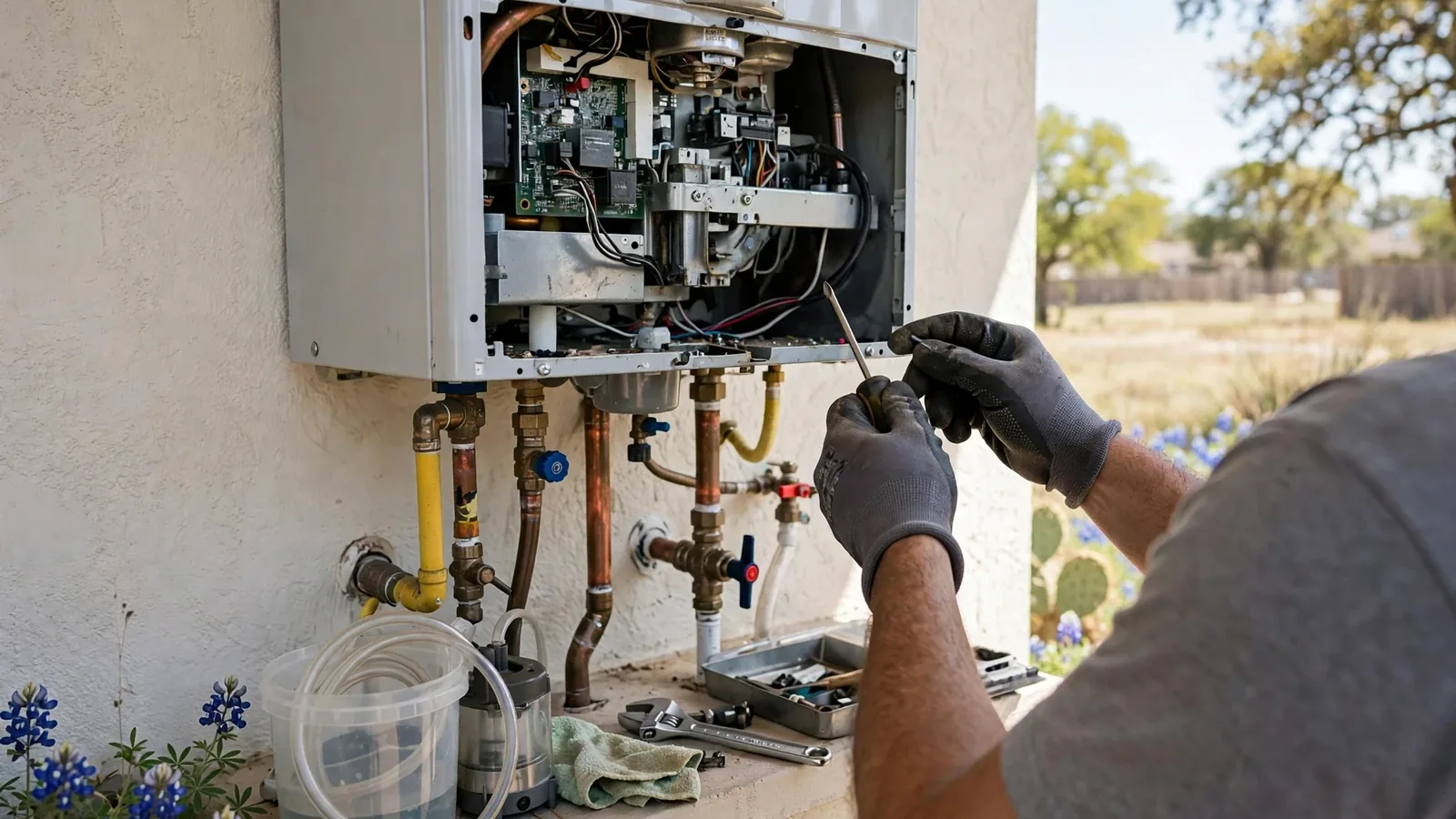
Where a Tankless Unit Actually Saves Energy
A storage tank keeps its whole volume hot around the clock. Even with a good insulating jacket, heat slowly leaks through the shell, and the burner or element cycles on to replace it. That standby loss happens whether anyone showers or not.
A tankless unit has no reservoir. When you open a hot tap, a flow sensor sees water moving and the burner or elements fire to heat it as it passes through the heat exchanger. When you close the tap, the unit shuts off.
The savings are biggest in homes that use modest hot water spread across the day, like a couple who showers once each morning. They shrink in a busy household that runs showers, a dishwasher and laundry back to back, because the unit is working hard much of the time anyway.
The tradeoff most brochures skip
Many people end up using more hot water once it never runs out. Longer showers eat into the savings. Tankless is a good fit for the comfort of endless hot water, and a smaller energy bill is a possible bonus, not a promise.
Gas or Electric Tankless: What Changes
The fuel decides almost everything else about the install: the venting, the gas line, the electrical panel and how much hot water you can push through at once. Here is how the two compare in a typical single family home.
| Factor | Gas tankless | Electric tankless |
|---|---|---|
| Flow capacity. | Higher, often enough for two showers at once. | Lower, often sized for one or two fixtures. |
| Venting. | Needs a sealed vent through a wall or roof. | No flue needed. |
| Fuel line. | May need a larger gas line than a tank used. | None. |
| Electrical. | A standard 120 volt outlet for the controls. | Often needs several dedicated high-amp breakers. |
| Install complexity. | Gas, vent and condensate work. | Panel capacity is the big question. |
Always have a licensed plumber confirm gas line size and panel capacity before you buy a unit.
What Crowley's Water Does to a Heat Exchanger
In 2025 the City of Crowley bought 100 percent of its treated surface water from Fort Worth, and the city's water quality report lists total hardness at 6 to 9 grains per gallon. That is hard water. As it heats, dissolved minerals drop out and coat the inside of the heat exchanger.
For a tankless owner this is the single biggest upkeep item. A scaled exchanger transfers heat poorly, so the unit burns more fuel or draws more power for the same hot water, and it can eventually throw error codes. Plan on periodic descaling, and ask us about a water softener or filter if you want to slow the buildup.
Source: City of Crowley 2025 Water Quality Report
Flow Rate: Size by Gallons Per Minute
Tanks are sized by gallons stored. Tankless units are sized by gallons per minute at a given temperature rise. That second part matters in North Texas, because incoming water is cooler in winter than in summer, so the unit has to work harder in January.
To size one, add up the fixtures you might run at the same time. A shower head is commonly in the range of 1.5 to 2.5 gallons per minute, a kitchen faucet around 1.5, and a dishwasher or washing machine adds a draw too. If two showers and a dishwasher could overlap, the unit has to cover all three.
What happens when you undersize it
The unit cannot reach set temperature at full flow, so you get lukewarm water or the controls throttle the flow down. A homeowner then blames the unit when the real problem was the sizing math. A proper load count at the start prevents that.
Venting and the Gas Line
A gas tankless unit exhausts hot, moist combustion gases and needs correct vent material and clearances. A condensing model produces acidic condensate that must drain to an approved spot. This is not a place to improvise with whatever pipe is in the garage.
Gas lines are the other surprise. A tankless burner can demand far more fuel at once than a tank burner, so the existing 1/2 inch line may be too small for the run. Crowley has adopted the 2021 International Fuel Gas Code, and the permit rules for a swap vary, so ask the Crowley building department before work starts.
If you smell gas at any point, leave the building and call the gas utility or 911 before you call a plumber. Do not flip switches or relight anything.
Descaling: The Upkeep That Protects Your Savings
Most manufacturers call for periodic descaling in hard water areas, and the schedule depends on your hardness and usage. A licensed plumber does the job in a visit, and it follows this rough pattern.
Shut off fuel and power.
The gas valve or the breakers go off first, and the cold water inlet is closed so the unit is isolated.
Connect a pump and a bucket.
A small pump circulates a descaling solution, usually a mild acid like white vinegar or a mild acid cleaner, through the heat exchanger via the service valves.
Flush and clean the filter.
After circulating for the recommended time, the exchanger is flushed with clean water and the inlet screen is cleaned of grit.
Restore and test.
Valves are reopened, the unit is restarted, and we check for leaks, temperature and any error codes.
What a Plumber Checks Before Quoting a Tankless Swap
Every house is different, so the quote comes after a look. These are the points that move the price, and you can see why a flat number over the phone would be a guess.
- Gas line size and length.Whether the existing pipe can feed the higher BTU load or needs to be upsized.
- Vent path.How far the exhaust must travel and whether the wall, attic or roof route is clear.
- Electrical capacity.Panel space and amperage, which matter most for electric models.
- Water quality.Hardness and whether a softener or scale prevention is worth adding.
- Location and access.Garage, closet or exterior wall, and whether the old tank's spot suits the new unit.
Why You Will Not See a Savings Figure Here
Any honest number would depend on your gas or power rate, your family size, your habits, your hardness and your unit's efficiency rating. We would rather explain the factors than invite you to trust a percentage that was never measured in your home. If you want help with a replacement, our water heater installation team can walk through your own usage and compare tank and tankless side by side.
A Local Angle: Growth and Planning
Crowley's population grew 40.8 percent between 2010 and 2020, and many homes in the city's newer subdivisions were built with a tank in a garage or closet. If you are replacing one near Burleson, our Burleson plumbers see the same upgrade question, and the same applies for neighbors in Forest Hill.
Whichever town you live in, call (817) 601-6266 and we can talk through whether tankless fits your layout. We are open 24/7, and same-day appointments are available when schedules allow.
Tankless Energy Questions
Usually it uses less energy than a storage tank because it avoids standby loss. The amount depends on your household's usage, fuel and upkeep, so we do not quote a percentage.
It depends on local gas and electric rates, which change. Gas units typically deliver more flow, while electric units skip the vent but may need a bigger panel.
Crowley's water is 6 to 9 grains per gallon hard, and scale builds up inside the heat exchanger over time. Regular descaling and, if you choose, a softener, slow that down.
Follow your manufacturer's schedule, and expect it to be more frequent with hard water. A licensed plumber can look at your unit and set a sensible interval.
Sometimes. The spot has to allow venting, clearances, gas supply and a drain for condensate, so we check before recommending it.
Permit rules vary, so ask the Crowley building department before work starts. We can tell you what we will need for a tankless install.