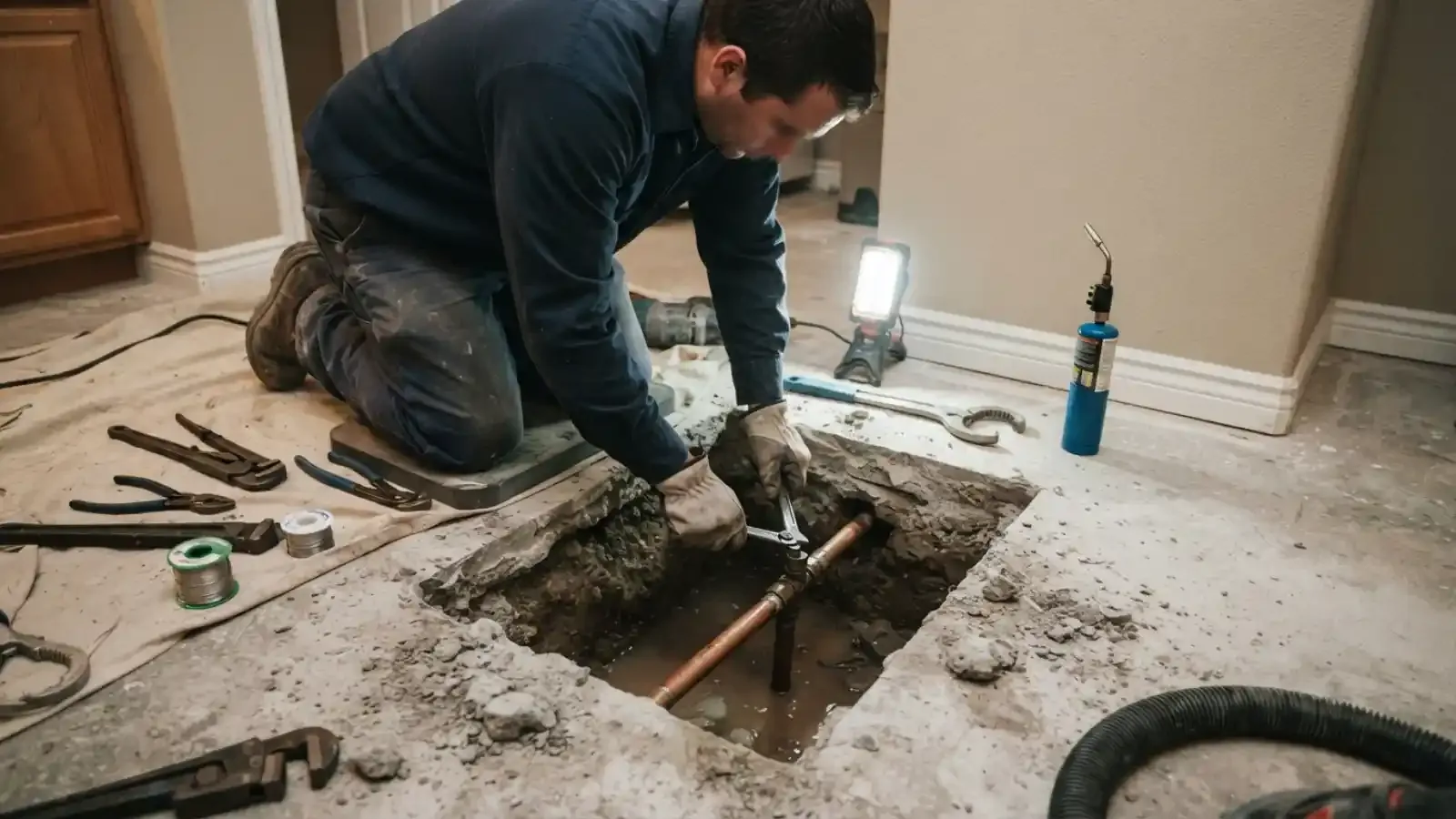
Signs the Leak Is Under the Slab
Slab leaks show up first in the bill. Look for these.
A water meter that keeps moving
Turn off every fixture and check the meter dial. If it still spins, water is going somewhere.
A warm spot on the floor
A hot water line leaking under tile or carpet can warm a patch you can feel with bare feet.
The sound of running water
A faint hiss or trickle in a quiet house, with nothing running, points to a pressurized leak.
Damp flooring or a musty smell
Lifted wood planks, soft carpet edges or a sour odor near baseboards can mean moisture coming up.
Why Slabs Leak in This Part of North Texas
Many homes here are built slab-on-grade, with supply lines running through or under the concrete. The clay-heavy soil in this part of North Texas swells when wet and shrinks when dry, so the foundation shifts over the seasons. That movement can rub a pipe against gravel or concrete until it wears through.
Water chemistry plays a part too. Hard water and chloramine disinfectant can wear on copper over decades, and a pinhole in a copper line is a classic slab leak. If your home is older, a pipe check may come up in the same visit.
Detection methods are industry practice rather than a code standard, but the repair that follows must meet the 2021 International Plumbing Code that Crowley uses.
The Detection Methods, Side by Side
A plumber rarely uses one tool alone. The methods below confirm each other, which narrows the spot we have to open.
| Method | What it finds | Cost impact |
|---|---|---|
| Pressure test. | Confirms whether a supply line is losing pressure. | Quick, but only says a leak exists. |
| Acoustic listening. | Pinpoints a leak by the sound of escaping water. | Needs a quiet house and access to the floor. |
| Thermal imaging. | Shows a hot water line leak as a heat pattern. | Good for hot lines, less for cold. |
| Electronic line tracing. | Maps the path of the pipe under the slab. | Helps pick the right place to open. |
| Tracer gas. | Releases harmless gas to find hard-to-hear leaks. | Extra time and equipment. |
Detection narrows the target. It does not repair the leak.
What Drives the Cost of Slab Leak Detection
We never print a number online, since a quote only makes sense after we know your layout. These are the factors that move it.
Homeowners policies usually cover sudden and accidental damage, such as a burst pipe, and usually do not cover slow leaks or wear. Some policies pay for the access needed to find a covered leak, so call your carrier before work if you plan to file.
A Crowley Code Detail That Affects Slab Pipe
Crowley's local amendment to the 2021 International Plumbing Code, Section 305.1, covers metallic piping in the ground. Metal pipe other than cast iron, ductile iron and galvanized steel must not touch corrosive soil directly, and sheathing must be at least 8 mil (0.008 inch).
For a homeowner this matters at repair time. If a leaking buried metal line is replaced or rerouted, the new run has to follow the local rule, so ask the Crowley building department how permits apply before a bigger repair starts.
Source: City of Crowley posted local amendments to the 2021 IPC
What You Can Safely Do Before We Arrive
Do not break the floor yourself. A few quiet checks help us and can limit damage.
Check the meter.
With all water off, watch the meter. Note whether it moves and write down the reading.
Close the main valve if water is pooling.
Shut the home's main valve and open one faucet to relieve pressure. Keep people away from wet outlets and panels.
Clear the area.
Move furniture and rugs off the damp spot so the floor can be inspected.
Take photos.
Photograph damp walls, warped flooring and your meter. This helps with any insurance claim.
Walk the House or Call Us
Some of this is yours to try. Some of it needs equipment.
What you can do yourself
- Read the meter with water off.
- Feel for warm floor spots.
- Listen in a quiet house.
- Shut the main valve.
When to call a plumber
- The meter moves with every fixture off.
- Water is lifting flooring.
- You hear running water inside a wall or floor.
- A bill jumps with no change in use.
What the Detection Visit Looks Like
A licensed plumber starts with the meter and a pressure test on the supply lines. If pressure drops, we isolate zones, like the water heater side, the kitchen side and the bath side, to narrow down which pipe is leaking.
Then comes listening. An acoustic ground microphone sits on the slab while the line is pressurized, and the sound is loudest right over the leak. A thermal camera checks hot lines for heat patterns. When the signals agree, we mark the floor and discuss repair options, including a slab leak repair by tunneling, opening the floor, or rerouting the line through the attic or walls.
Detection that is done carefully avoids unnecessary concrete cuts. That is the value of paying for it.
Nearby Homes, Same Soil
Our crews cover Crowley and the towns around it. Homeowners in Burleson and Everman face the same clay soil that moves slabs, so the same detection methods apply. Call early, because a small pinhole leak under a floor only gets worse and bills climb the longer it runs.
Slab Leak Detection Questions
It depends on access, depth, the methods used and the number of leaks. We give a clear price before work starts, after we know your layout.
No. Detection finds the leak. Repair is a separate decision, such as tunneling under the slab, opening the floor or rerouting the line.
Policies often cover sudden and accidental damage and may cover the access needed to find a covered leak. Slow leaks and wear are usually excluded. Ask your carrier before you file.
Yes. A local amendment to the 2021 IPC, Section 305.1, requires sheathing of at least 8 mil on metallic piping in direct contact with corrosive soil, with some exceptions. Ask the Crowley building department how it applies to your job.
Yes. Pressure tests, acoustic listening, thermal imaging and line tracing locate the leak from above. Concrete is opened only after the spot is confirmed.
We are open 24/7. If water is pooling, shut off your main valve and call us.