If You Smell Gas, Do This First
Leave, then call.
Do not flip switches, light anything, or use a phone inside the house. Walk out, then call your gas utility or 911.
Gas heater work waits until the utility says the leak is cleared. Never try to relight a pilot on a system you suspect is leaking.
Gas Versus Electric: Where the Trouble Usually Starts
Start with the heater type, because the checks differ.
| Symptom | Gas tank | Electric tank |
|---|---|---|
| No hot water at all | Pilot out, bad thermocouple, no gas | Tripped breaker, failed upper element or thermostat. |
| Lukewarm water | Dirty burner, low flame, sediment | Failed lower element or thermostat. |
| Water runs out fast | Sediment, failed dip tube | Failed lower element, sediment. |
| Rumbling or popping | Sediment hardening on the tank floor | Sediment covering elements. |
| Rotten egg smell | Anode rod reacting with bacteria | Same cause, often the anode rod. |
Rotten egg smell from hot water only is usually the anode rod. A gas smell near the heater is a different problem. See the box above.
What to Do at the Tank Before You Call a Plumber
Each check below needs no repair tools beyond a flashlight and a screwdriver.
Gas: look at the pilot
If the pilot is out and there is no gas smell, follow the instructions on the tank label. If it will not stay lit, stop. A bad thermocouple needs a plumber.
Electric: reset the breaker
Check the double-pole breaker and the red reset button on the upper thermostat. If it trips again, a shorted element is likely. Turn power off before opening any panel.
Check the temperature setting
A setting near 120 degrees is common. Turned down by mistake, a tank feels weak.
Look for a wet floor
Drips from the bottom point to a tank leak, which means replacement. Drips from the relief valve have other causes.
Anode Rods, Elements and Thermostats Explained
The anode rod is a magnesium or aluminum rod screwed into the top of the tank. It corrodes on purpose so the steel tank does not. Once the rod is eaten down to the core wire, the tank starts to rust, and a rotten egg smell often shows up first.
On electric tanks, two screw-in elements heat the water, each controlled by its own thermostat. If the upper element fails, you get no hot water. If the lower one fails, you get a short supply. A multimeter shows continuity, but turn the power off at the breaker before opening any access panel.
A common mistake is turning the thermostat way up to fix a weak tank. Water above 120 degrees raises scald risk without fixing the underlying failure. If the temperature setting was never the problem, adjust it back and look elsewhere.
Water heater safety follows manufacturer instructions and plumbing code standards. According to those guidelines, never remove or plug a T&P valve, and leave gas appliance work to a licensed plumber.
What the Crowley Water Report Says
The City of Crowley 2025 Water Quality Report lists chloramine as the disinfectant, with a 2025 average of 2.56 ppm, and a pH range of 7.8 to 8.5. The water is hard at 6 to 9 grains per gallon in the same report.
For your tank, that mix is why sediment builds up and why the anode rod, a sacrificial metal rod inside, wears out. Hard water leaves scale on elements and the tank floor. If your tank is near the end of the typical 8 to 12 year life, a failing anode is a good reason to plan for replacement rather than another repair.
Source: City of Crowley 2025 Water Quality Report
Flush the Tank to Clear Sediment
A yearly flush clears the scale that causes rumbling and weak output. It takes about an hour.
Turn off power or gas.
Set the breaker off or the gas control to pilot. Let the water cool for a few hours so a hose does not scald you.
Connect a hose.
Attach a garden hose to the drain valve and run it to a floor drain or outdoors, downhill from the heater.
Open a hot tap and the drain.
Open a hot faucet upstairs to break the vacuum, then open the drain valve. Let water run until it clears.
Close up and refill.
Close the drain valve, remove the hose, and refill with the cold supply open and a hot tap running until air stops spitting.
Restore power or gas.
Only turn power on after the tank is full. Turning an electric element on a dry tank burns it out.
Repair It or Replace It
Age and the failure type decide the answer.
Repair makes sense
- The tank is under about 8 years old.
- The failed part is an element, thermostat, igniter or valve.
- There is no leak from the tank shell.
- Hot water ran well until recently.
Replace makes sense
- The tank leaks from the body or bottom.
- It is past roughly 10 to 12 years.
- Several parts have failed in a short time.
- You want to move to a tankless unit.
What a Licensed Plumber Looks At
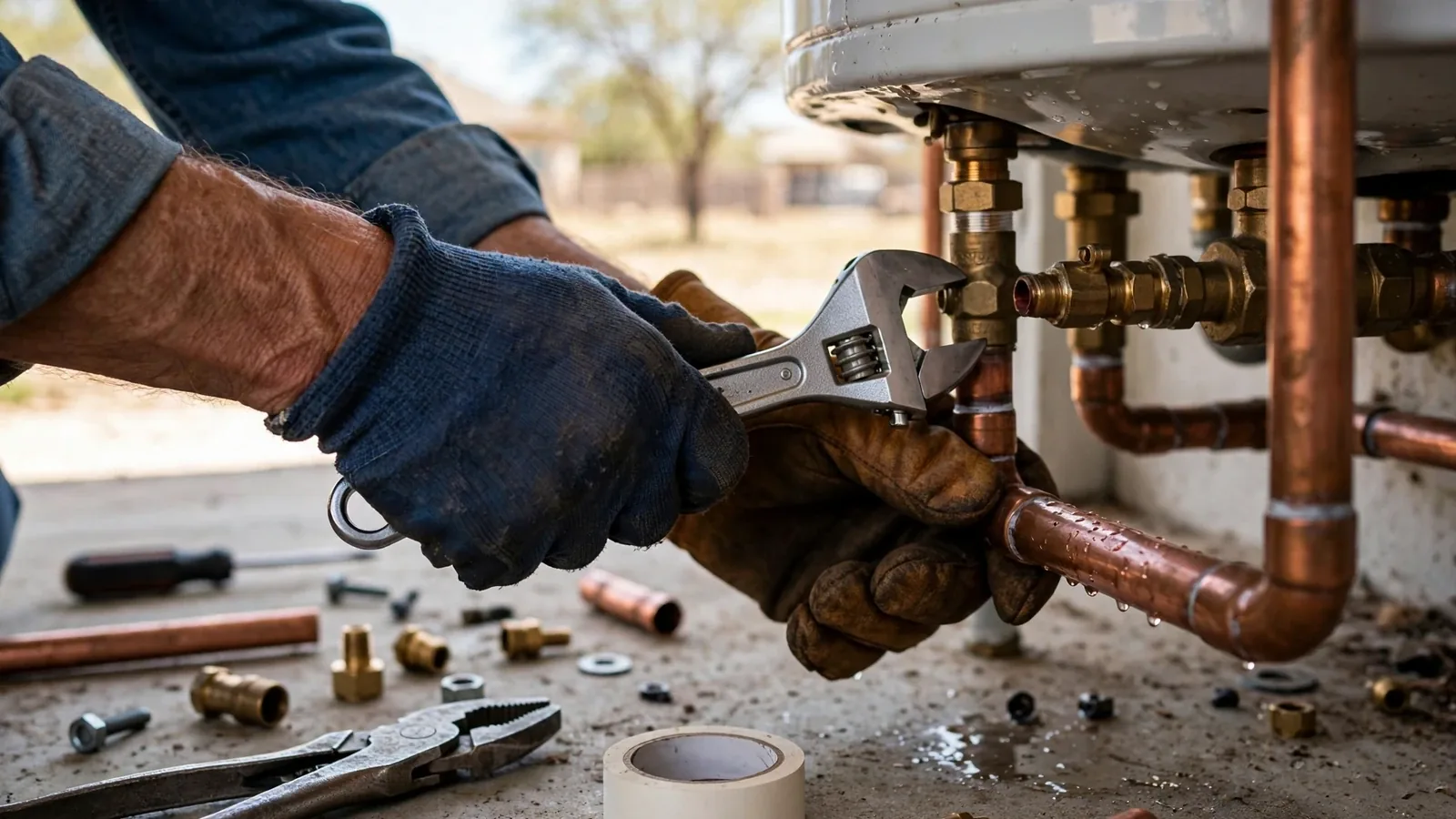
We start with safety: gas leaks, combustion draft, venting and the temperature and pressure relief valve. A multimeter checks elements and thermostats on electric tanks. A manometer or leak detector checks gas supply and connections.
We tell you plainly what is worth repairing. If the tank shell is leaking or the unit is old, a fix is only a delay. Our water heater repair team will give a clear price before work starts. Some homeowners then move to a tankless water heater for continuous supply.
What Affects the Cost of Water Heater Repair
Parts are rarely the biggest factor. These are.
Homeowners policies usually cover sudden and accidental damage like a tank that bursts, and usually not wear or slow leaks. Ask your carrier.
Water Heater Help in Crowley and Nearby
We handle heaters around Crowley and in Burleson, Everman and Forest Hill. Same-day appointments are available when schedules allow. If your tank is flooding the garage, shut off the cold supply and power or gas first, then call.
Water Heater Repair Questions
On gas tanks, check the pilot and gas supply. On electric tanks, check the breaker, reset button, thermostat and elements.
Only if there is no gas smell and the tank label gives instructions. If it will not stay lit, call a plumber.
Yes, if power or gas is off and the tank is cool. Open a hot tap first and never turn on an electric element on a dry tank.
Tanks typically last 8 to 12 years. Hard water at 6 to 9 grains per gallon in Crowley wears anode rods and builds sediment.
Usually bacteria reacting with the anode rod. A plumber can swap the rod or treat the tank.
Leave the house and call the gas utility or 911 before calling a plumber.