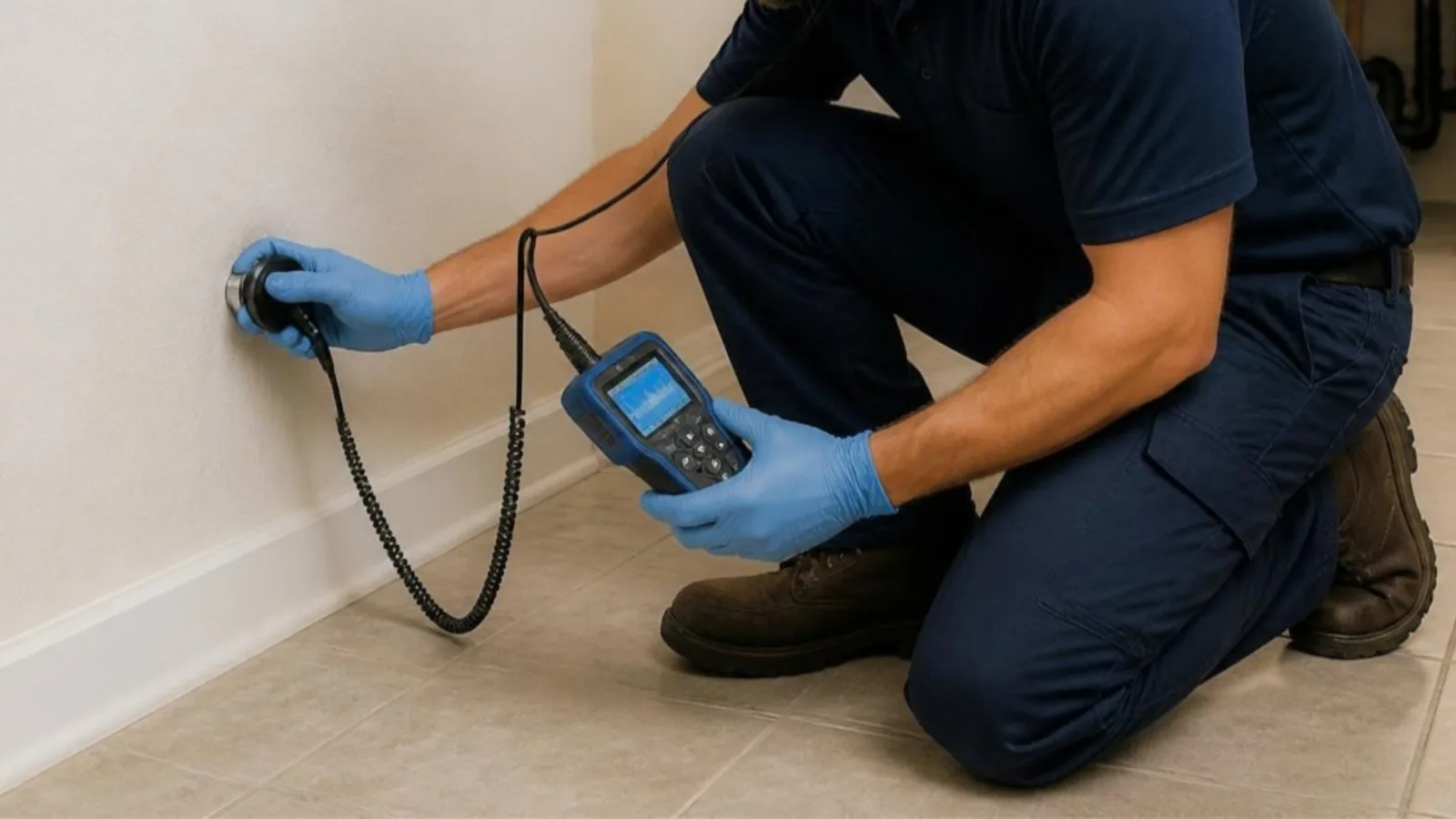
How Listening Finds a Leak Through Concrete
Water escaping a pinhole under pressure makes noise. The sound travels along the pipe wall, through the soil and up through the slab, and it is loudest directly above the break. A ground microphone picks it up, and a handheld unit with headphones and a screen shows pitch and volume.
Before anyone listens, the house has to be quiet. Every fixture is off, the ice maker is paused, the irrigation controller is stopped and the washer is idle. The main valve is opened fully so the line holds its normal household pressure, often somewhere between 40 and 80 psi.
The technician then walks a grid across the floor and marks the loudest spots in chalk. Sound can ride a copper line for twenty feet or more, so one reading proves nothing. Two or three marks that line up along a pipe run are what point to the leak.
A listening test is a diagnostic method, not a code standard, so the repair that follows still has to meet the plumbing code. Crowley has adopted the 2021 International Plumbing Code.
Four Methods, Four Different Jobs
No single tool finds every leak. A good leak detection visit often combines two of these, because each one is strong where another is weak.
Acoustic listening
Best for pressurized supply lines under a slab or behind a finished wall. It cannot hear a drain line, because a drain is not under pressure, and it struggles on plastic pipe that muffles sound.
Tracer gas
A harmless mix of hydrogen and nitrogen, typically about 5 percent hydrogen, is pushed into an isolated line. The gas escapes through the break and a sniffer finds it at the surface. It suits plastic pipe and slow leaks that barely hiss.
Thermal imaging
An infrared camera shows temperature differences on a surface. A leaking hot line leaves a warm patch on the floor, and a wet wall reads cooler than dry drywall. It needs a gap of a few degrees to read clearly.
Pressure testing
Test plugs isolate one section of pipe and a gauge watches it. If the needle falls with nothing running, the leak is inside that section. This confirms a leak exists and tells us where to point the microphone.
What Crowley's Water Tells You About Hidden Leaks
The City of Crowley water system (PWS ID 2200034) bought 100 percent of its treated surface water from the City of Fort Worth in 2025. The same report lists pH between 7.8 and 8.5, which is mildly alkaline.
For you, that means the water itself is not acidic enough to be the usual suspect for eating through copper from the inside. When a Crowley line leaks, the cause is more often outside the pipe, such as soil movement, a bad joint, or rubbing against concrete. That is why we locate the leak first instead of guessing at the pipe.
Source: City of Crowley 2025 Water Quality Report
Matching the Symptom to the Method
Here is how the usual complaints map to a first test. The right choice depends on pipe material, pipe depth and whether the line is hot or cold.
| What you notice | Usual first method | Why it fits |
|---|---|---|
| Meter moves with all fixtures off. | Pressure test, then acoustic. | Confirms a supply leak and which zone, then the microphone narrows it. |
| Warm spot on a tile floor. | Thermal imaging, then acoustic. | A hot line leaves heat that a camera reads at once. |
| Sound of running water at night. | Acoustic listening. | The hiss is exactly what the sensor is built to hear. |
| Plastic or PEX line, quiet leak. | Tracer gas. | Gas escapes where sound will not carry. |
| Damp wall, no visible source. | Thermal imaging and moisture meter. | Maps the wet area before any drywall is opened. |
Drain and sewer leaks are found differently, usually with a camera, since a drain line carries no steady pressure.
What You Can Safely Check Before We Arrive
A few minutes of checking makes the visit faster and tells us what to bring. None of this needs tools.
- Read the meter.With every fixture off, watch the small triangle or dial for ten minutes. Any movement means water is leaving the system somewhere.
- Feel the floor.Walk barefoot across tile or slab. A patch that stays warm when no hot water is running often sits over a leaking hot line.
- Listen at night.Stand near the water heater and the main shutoff in a quiet house. A faint hiss or tick that never stops is useful information.
- Note the pattern.Write down whether the bill rose slowly or jumped, and whether hot or cold taps sound different. Hot-only and cold-only clues change the plan.
- Find the main valve.Make sure you can turn it off by hand. If it will not turn or drips at the stem, tell us when you call.
When to Stop Looking and Call
Stop if you see water near an outlet, a panel or any electrical device. Keep people and pets away from that area and shut the main water valve if you can reach it without stepping through water. Do not open walls or break tile to chase a sound.
Also call if the floor feels warm in a wide patch, if a wall is bowing or if you smell mustiness that returns after cleaning. Those point to a leak that has been running long enough to soak materials. If the problem is active, call (817) 601-6266 and we can dispatch day or night.
What a Plumber Does Once the Leak Is Located
Finding the leak is only half the job. With a chalk mark on the slab and a pressure reading in hand, the plumber explains the options before any work starts: a spot repair, a reroute through the attic or walls, or a section of new pipe. You get a clear price before work starts.
If the break is under the foundation, the next step is usually slab leak repair, which can mean a small tunnel or a bypass line. If it is in the yard between the meter and the house, a water line repair with a short trench is more typical. Your plumber can walk you through which applies.
We work across Crowley and also take calls from neighbors in Burleson, Everman and Forest Hill. Wherever the house is, the sequence stays the same: confirm, listen, verify with a second method, then mark and repair.
Questions About Finding Hidden Leaks
Yes, in most cases when the line is a pressurized copper supply. The sound transmits through the pipe and concrete, and the loudest point is marked on the floor. Plastic pipe and very small leaks are quieter, so we may confirm with tracer gas.
Listening, thermal imaging and pressure testing do not. Tracer gas needs access to the pipe ends and sometimes a small test point. Nothing is cut until the location is confirmed with at least one method.
A simple pressure test and a listening pass can fit in a short visit. A large house, a deep line or a leak that needs gas takes longer. We will tell you what to expect when we see the layout.
The City of Crowley report lists pH of 7.8 to 8.5 and total hardness of 6 to 9 grains per gallon. That alone does not predict a leak. Most hidden leaks we trace come from joints, abrasion or ground movement, so a test is the only way to know.
Ask Public Works where the city side ends, since that boundary is not posted on the city pages we reviewed. The main number is 817-297-2201. For an after-hours water break the city lists Police Dispatch at 817-297-2276.
Homeowners policies usually cover sudden and accidental damage and usually not slow leaks or wear. Some carriers do pay for finding the source. Call your carrier before the visit and ask about the wording.