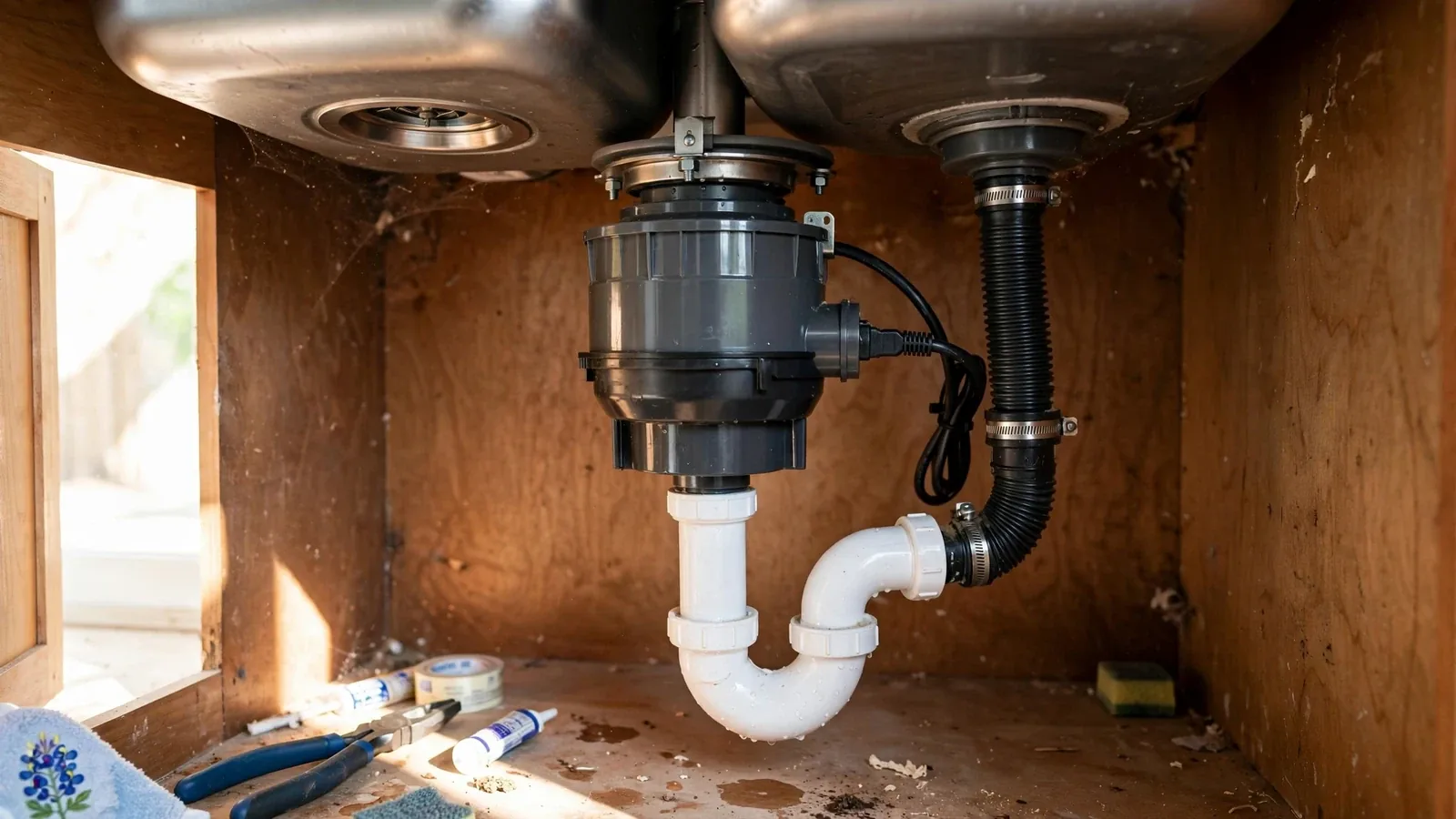
Before Anything Else: Shut It Off and Keep Hands Out
Never reach into a disposal.
Keep your hand out, even with the power off. Use tongs or pliers to pull out stuck items. Turn the wall switch off and unplug the unit under the sink, or flip the breaker if the cord is wet.
A jammed disposal can start suddenly when the jam clears, and the blades are sharp. If the cabinet floor is wet and the outlet sits low, stay clear and call. Water and an energized cord are a shock hazard. If the cord is wet, do not touch it.
Symptom, Cause and What Happens Next
This table helps you decide if the fix is quick or if the unit is done.
| What you notice | Likely cause | Typical fix |
|---|---|---|
| Humming, no spin. | Jammed flywheel. | Free it with a hex key from below, then press reset. |
| Silent, no hum. | Tripped overload or dead outlet. | Press the red reset button on the base and check the breaker. |
| Drips from the top. | Loose sink flange or old plumber's putty. | Remount the flange with fresh sealant. |
| Drips from the side. | Cracked housing or failed internal seal. | Replace. The housing cannot be fixed. |
| Leaks at the drain elbow. | Loose or worn gasket on the drain pipe. | Tighten or replace the gasket. |
| Sink backs up but the disposal runs. | Clogged trap or branch line. | Clear the line. See drain cleaning. |
Clearing a Jam with a Hex Key and the Reset Button
Jams are the most common call and often the simplest fix.
Power off and unplug.
Turn off the wall switch and unplug the unit or shut the breaker. Do not skip this.
Turn the flywheel.
Most disposals have a 1/4 inch hex socket in the center of the underside. Insert the hex key and work it back and forth until the shaft turns freely.
Remove the item.
Look into the chamber with a flashlight and pull out anything stuck using tongs, never your fingers.
Press reset and test.
Press the red button on the bottom. Restore power, run cold water and flip the switch. If it hums again, stop and call a plumber.
Finding the Source of a Leak
Water under the sink is not always the disposal. Dry the cabinet, run water and watch for the first drip.
At the flange
Water at the top of the unit, where it meets the sink, points to a failing seal. The flange can usually be pulled and resealed.
At the drain pipe
A drip where the elbow meets the disposal is typically a gasket or loose bolts. It is a short repair that sometimes needs a new trap arm.
At the dishwasher hose
The dishwasher drain connects to a nipple on the disposal. A cracked hose clamp or a clog can send water into the cabinet. A high loop or an air gap on the countertop keeps dirty water from flowing back.
Hard Water, Grease and Why Disposals Clog Drain Lines
Crowley water is rated at 6 to 9 gpg, according to the City's 2025 report. That hardness leaves mineral scale on the inside of drain lines and on the disposal's grinding ring. Scale narrows the pipe, and food scraps and grease catch on it.
Kitchen grease is the other half of the problem. Fat poured down the sink coats the lines and hardens as it cools, and the disposal grinds it into smaller pieces that stick. If your kitchen drain slows down even after the disposal is working, the fix is the line, not the unit. A hydro jetting visit clears grease and scale more thoroughly than a snake.
Repair or Replace the Disposal
A disposal is not built to last forever, and some fixes cost more than the unit is worth.
Repair makes sense when
- The unit is only jammed or needs a reset.
- The leak is at the flange, drain gasket or dishwasher hose.
- The motor spins freely and the housing is intact.
- The unit is only a few years old.
Replace makes sense when
- The housing is cracked or leaks from the sides.
- The motor hums or trips the reset over and over.
- The grinding parts are rusty or the unit is more than about 8 to 12 years old.
- The disposal is too small for how the household cooks.
Disposal leaking or sink backed up?
Call any hour. A licensed plumber can schedule a same-day visit when available.
What Affects Garbage Disposal Repair Cost
We tell you the price before we start.
Homeowners insurance usually covers sudden and accidental water damage, such as a disposal that bursts and floods the cabinet. It usually does not cover a worn-out unit or a slow drip, so check with your carrier.
Garbage Disposal Questions
Yes. We are open 24/7 and schedule same-day visits when available. If water is leaking into the cabinet, switch off the disposal and the breaker, close the sink shutoffs and call.
Turn it off and unplug it, then use a hex key in the bottom socket to turn the shaft back and forth. Pull out any stuck item with tongs. Press the red reset button and test. If it hums again, call a plumber.
Do not. Even with the power off, the blades are sharp and a jammed unit can shift. Use tongs or pliers for stuck items.
Leaks from the bottom or side point to a cracked housing or failed seal inside the unit. That cannot be repaired, so plan on replacement. Shut off the power and place a bucket under the unit.
An air gap is a small fitting on the countertop that keeps dirty water from flowing back into the dishwasher. Some homes use a high loop in the drain hose instead. Either one can fail or clog, and then water backs up into the sink.
Most last around 8 to 12 years, depending on use and what goes down them. Hard water and grease shorten that life. A unit that is jammed often or runs loudly is nearing the end.