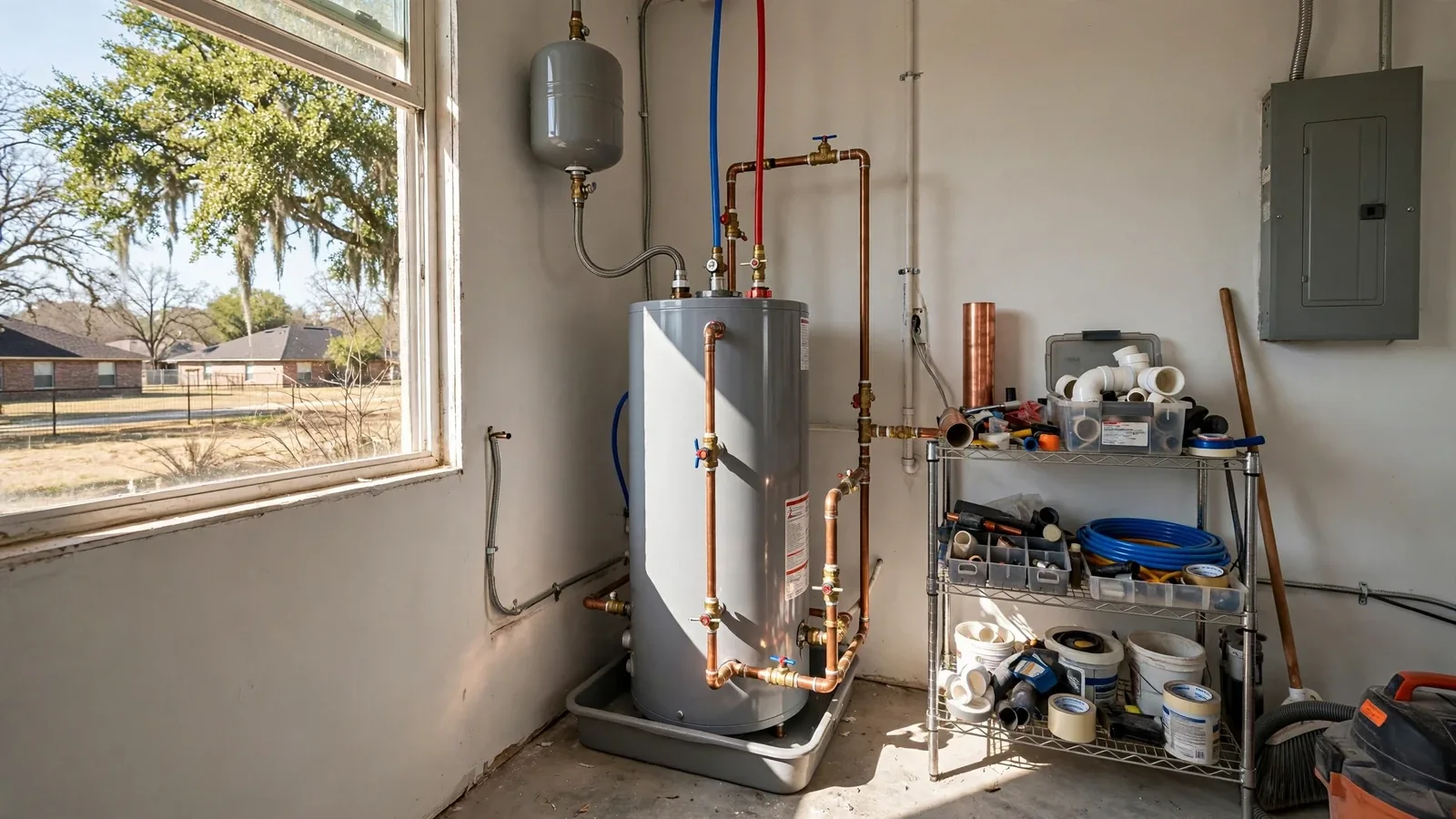
The First Ten Minutes
Speed matters, but so does staying dry and safe. Do these in order.
Stop the heat source.
For an electric heater, turn off the breaker for the water heater at the panel, and do not touch the panel if the floor is wet. For a gas unit, turn the gas control knob to off. Skip this step if you smell gas and leave instead.
Close the cold supply.
Find the shutoff valve on the cold pipe above the tank, usually a lever or a round handle, and turn it fully closed. This stops fresh water from feeding the leak.
Catch and divert the water.
Slide a shallow pan, towels or a wet vac under the drips. If water is running across the floor, move anything valuable out of its path.
Relieve pressure if needed.
Open a hot faucet in the house to let the tank pressure drop. Do not open the drain valve on a hot tank because the water can scald.
Take photos and call.
Photograph the unit, the data plate and the wet area. Then call a licensed plumber so they know what to bring.
If You Smell Gas
Leave first, call second
A rotten egg odor near a gas heater means leave the building right away, with everyone and every pet. Call the gas utility or 911 from outside. Do not flip switches, use a lighter or try to relight a pilot. Call a plumber only after the utility says the house is safe.
Where the Water Is Coming From
The location of the leak usually tells you if you face a repair or a replacement.
Temperature and pressure valve
The T&P valve sits near the top or side with a discharge pipe running down. A drip here can mean excess pressure, thermal expansion or a worn valve. A valve that runs steadily needs attention at once.
Supply and outlet fittings
Water on top of the heater, or around the cold and hot connections, often comes from a loose or corroded fitting. These can often be fixed without touching the tank.
Drain valve
A slow drip at the lower drain valve is common after a flush. Sometimes the washer or the valve itself can be changed.
Tank body
Water from underneath or through the jacket points to a rusted-through tank. There is no safe patch for it, and the unit has reached the end of its life.
Crowley's Hardness and Your Tank
The City of Crowley 2025 Water Quality Report lists total hardness of 108 to 150 mg/L as CaCO3, which the report states as 6 to 9 grains per gallon. That is moderately hard water.
For your tank, this means minerals settle as sediment at the bottom, form a layer that insulates the water from the burner or element, and can accelerate corrosion in the steel. Flushing a tank each year and checking the anode rod are cheap ways to slow that damage.
Source: City of Crowley 2025 Water Quality Report
Repair or Replace: A Quick Guide
Age, leak location and condition decide it. Tank life is typically around 8 to 12 years.
| What you see | Likely verdict | Reason |
|---|---|---|
| Drip at the relief valve discharge. | Repair. | A new T&P valve is a small part, though recurring drips can hint at pressure trouble. |
| Leak at a fitting on top. | Repair. | Tighten or replace the connector and test again. |
| Leak at the drain valve. | Repair. | Swap the valve if it will not seat. |
| Water under the tank, heater under 8 years. | Usually replace. | Tank leaks cannot be patched, and a warranty may apply. |
| Water under the tank, heater over 10 years. | Replace. | The tank has lived its normal life and corrosion is widespread. |
A rusty tank with sediment noise often fails soon, even when the leak looks small.
Why Tanks Leak From the Bottom
Inside every steel tank is a glass lining and a sacrificial anode rod. The rod corrodes first to protect the steel. Once the rod is used up, rust starts at flaws in the lining, and the tank wall thins until water seeps through.
Sediment speeds that process because it traps heat and cooks the lining at the bottom of a gas unit. When you hear popping or rumbling, that is steam bubbling through the mineral layer. If the sound is new and the tank is old, plan for a replacement before the leak starts.
Manufacturer guidelines and the plumbing code both treat a leaking tank as end of life, since a tank that has failed internally cannot be repaired. A leaking fitting or valve is a different, fixable problem.
What You Can Do and What to Leave Alone
Some jobs are safe for a careful homeowner. Others carry real risk.
Safe to do yourself
- Shut off power or gas and the cold supply.
- Place a pan and mop up water.
- Check the discharge pipe for drips.
- Tighten a hand-loose fitting with a wrench only if the tank is cool.
Leave to a licensed plumber
- Replace a T&P valve or disconnect piping.
- Drain a hot tank.
- Work on gas lines, vents or burners.
- Relight a pilot on a unit that has leaked.
What Moves the Cost of a Leaking Heater Fix
We quote after we see the unit, with a clear price before work starts. The numbers shift based on a handful of factors.
Homeowners policies usually cover sudden and accidental water damage, such as a tank that bursts, and usually not slow leaks or wear. Take photos and ask your carrier what they cover.
What We Do When We Arrive
A licensed plumber confirms the source, checks the pressure and reads the data plate for age. We tell you whether it is a repair or a replacement, and you get a clear price before work starts. If it is a fitting or valve, our water heater repair team can often finish the job in a single visit.
If the tank has failed, water heater replacement means draining the tank, disconnecting and removing it, installing the new unit with a drain pan, T&P discharge line and code connections, and testing. We also take calls from Burleson, Everman and Forest Hill, and you can call (817) 601-6266 any hour.
Leaking Water Heater Questions
It can be. Water on the floor can damage walls and flooring fast, and a heater near electrical items is a safety concern. Shut off the power or gas and the cold supply, then call.
Closing the cold valve at the heater is usually enough. If you cannot reach it, shut the home's main valve.
If the leak is at the tank wall, no. Fittings, valves and connectors can be fixed, but a rusted tank needs replacement.
Thermal expansion, high house pressure or a worn valve are the usual causes. A valve that runs often should be checked by a licensed plumber.
The city pages we reviewed do not say, so ask the Crowley building department at 817-297-2201, ext. 3000. Permit rules vary by the job.
The City of Crowley report lists hardness of 6 to 9 grains per gallon. Sediment can build up and shorten life if the tank is never flushed. A yearly flush and anode rod check help.
Leave the building at once, take everyone out, and call the gas utility or 911 from outside. Do not call a plumber first, and do not try to relight anything.