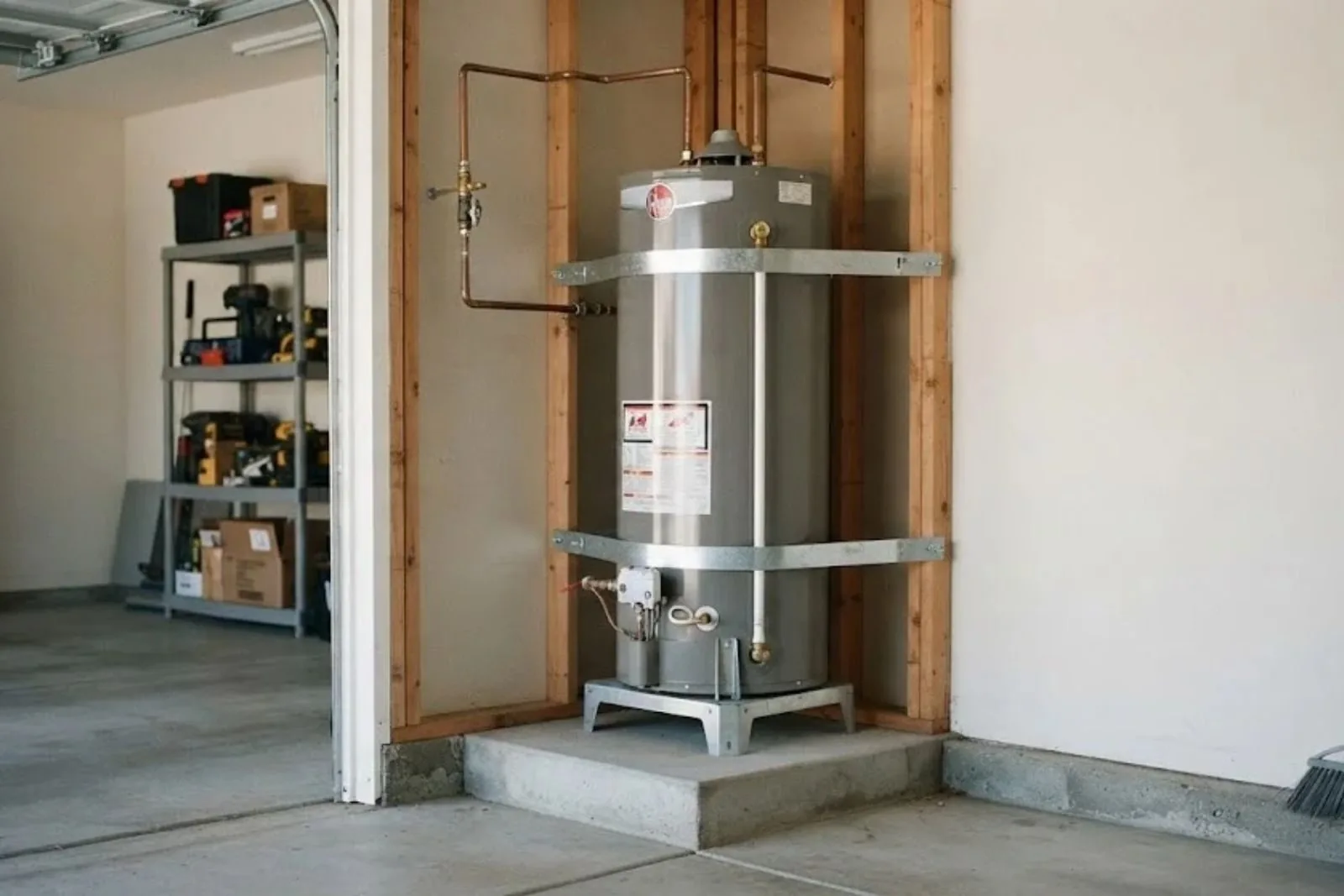
What the Valve Is There to Do
The temperature and pressure relief valve is a spring-loaded brass safety. It opens if tank pressure passes about 150 psi or water reaches roughly 210 degrees. It then dumps hot water down a discharge pipe so the tank cannot rupture.
A tank that has lost its relief valve is a bomb with a pilot light. That is why the valve is the one water heater part never to cap, plug or remove. When it drips, the cause may be the valve itself, or it may be a symptom of high water pressure or thermal expansion, which needs a different fix.
The T&P valve is a code-required safety device. The 2021 International Plumbing Code, which Crowley has adopted, sets the standard for its discharge pipe, so a valve swap is not a place to improvise.
Signs Your Pressure Valve Needs Attention
Check the valve before you check the rest of the heater. It sits on the side or top of the tank.
Slow drip from the discharge pipe
Often a worn seat, scale in the valve, or thermal expansion pushing pressure up on each heating cycle.
Steady stream
Excess pressure or temperature. Shut off power or gas and cold supply, then call. Do not touch the valve.
Corrosion or crust on the valve
Mineral crust and green or white buildup mean the lever may be seized.
Valve will not release when tested
A valve that does not flow when you lift the lever, or flows and refuses to close, needs replacement.
DIY Swap or Plumber Visit
This job is a trade-off between speed and risk. The tank holds 40 to 50 gallons of hot water under pressure.
Reasonable to try yourself
- Valve is dripping and the tank is cool.
- Power or gas is off and cold supply is closed.
- You have a proper valve with the same pressure and temperature ratings.
- The discharge pipe is intact and routes safely downward.
Leave it to a plumber
- You smell gas or see scorching.
- The valve sprays hot water or steam.
- Fittings are corroded or the tank leaks.
- Discharge pipe is missing, capped or runs uphill.
How to Replace a T&P Valve Safely
Skip any step you cannot do safely. A gas smell means stop and leave.
Cut power or gas and let it cool.
Turn the breaker off or the gas control to pilot or off. Wait for the tank to cool. Hot water at 120 degrees or higher scalds quickly.
Close cold supply and relieve pressure.
Close the cold inlet shutoff. Open a hot tap in the house, then lift the valve lever briefly so the tank pressure drops. Keep your face and hands clear.
Drain a few gallons.
The valve sits above water level. Drain a gallon or two from the tank drain valve so water is below the valve opening.
Remove the old valve.
Disconnect the discharge pipe, then unscrew the valve counterclockwise with a pipe wrench. Check threads for damage.
Install and test.
Wrap the new valve threads with thread seal tape or compound, snug it, reconnect the discharge pipe, restore water, and check for drips before power or gas returns.
Permits and the Crowley Building Department
The City of Crowley Community Development office is at 201 E. Main Street. Permits are 817-297-2201 ext. 3000 and inspection requests are ext. 3020. Hours are Monday to Thursday 7:30 a.m. to 5:30 p.m., and Friday 7:30 a.m. to 11:30 a.m.
The city pages do not say whether a simple valve swap needs a permit, so permit rules vary and you should ask the Crowley building department before you start. Replacing the whole tank is a bigger question, and our water heater replacement team can tell you what usually applies.
Source: City of Crowley Community Development page
Valve Ratings and Discharge Pipe Basics
Check these before buying a part. The specifics come from the tank label and local code.
| Item | What to check | Why it matters |
|---|---|---|
| Pressure rating | Matches or sits at or below the tank's rated pressure | Opens before the tank is stressed. |
| Temperature rating | Typically 210 degrees | Protects against overheated water. |
| BTU or kilowatt rating | At least the heater's input | Must be able to vent enough steam. |
| Probe length | Reaches into the top of the tank water | Senses real tank temperature. |
| Discharge pipe | Same size as valve outlet, runs downward, no cap | Carries scalding water away safely. |
Discharge pipe material and termination rules differ by code and by city. Ask the Crowley building department.
Why the Valve Keeps Dripping After Replacement
A new valve that still drips usually points to excess system pressure. Fort Worth surface water arrives at the meter with city pressure, and a closed-loop plumbing system has nowhere to push heated water. Thermal expansion raises pressure every time the tank heats, and the valve takes the blame.
An expansion tank on the cold line absorbs that extra volume, and a pressure reducing valve at the house can lower incoming pressure. A pro tests with a gauge on a hose bib to see where pressure sits. Our water heater repair visits start with that reading when a valve drips again.
What a Licensed Plumber Handles Differently
We shut down fuel and power, confirm the tank is below scalding temperature, and relieve pressure before loosening anything. We check the discharge pipe, the thread condition, and combustion venting when the heater is gas. We do not install a valve with the wrong rating just because the threads fit.
If the tank itself is leaking or the shell is rusted, the valve is not the real problem. Water heaters last around 8 to 12 years, and a failing tank is cheaper to replace than to chase. We will say so plainly, with a clear price before work starts.
What Affects the Cost of Valve Replacement
The valve is a small part. The labor and the underlying cause drive the cost.
Homeowners policies usually cover sudden and accidental water damage and usually not wear or slow leaks. Ask your carrier.
Neighbors and Nearby Towns
We cover the same service from Burleson to Everman and Forest Hill. Tank age and local water pressure vary by street, so a quick call helps us advise on whether the valve or the whole heater is the right fix.
Pressure Valve Questions
With the discharge pipe in place and a bucket under it, lift the lever briefly. Water should flow and the valve should reseat. Do this carefully, since the water is hot.
No. Capping defeats the safety function. Fix the cause or replace the valve.
The valve seat may be worn or scaled, or excess pressure or heat is forcing it open.
Many plumbers suggest replacing it when the heater is replaced and testing it yearly.
The city pages do not say. Call the Crowley permits office at 817-297-2201 ext. 3000 and ask.
No. Power or gas should be off and the tank cool and depressurized.